
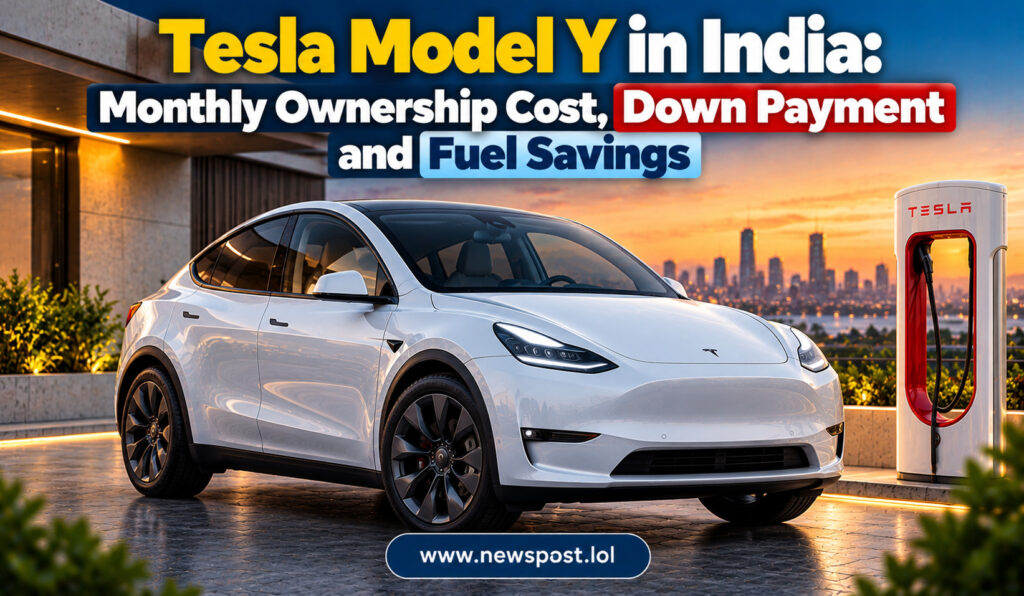

The Tesla Model Y has brought a different kind of electric SUV ownership experience to India. With its minimalist cabin, long driving range, advanced software and all-electric powertrain, it targets buyers looking for a premium alternative to conventional petrol and diesel SUVs. However, its purchase price is only one part of the ownership equation. Down payment, monthly EMI, home-charging expenses, insurance and potential fuel savings all influence the actual cost of owning one.
Tesla has also promoted financing plans that make the Model Y more accessible through lower initial payments and structured monthly instalments. But how much does it really cost to own the electric SUV every month? Here is a practical breakdown of its Indian prices, financing examples, electricity expenses and possible savings compared with a petrol SUV.
Tesla Model Y Price in India and Available Variants
As of October 2026, Tesla’s Indian Model Y range includes two options. The five-seat Model Y Premium RWD is priced at ₹50.89 lakh, while the six-seat Model Y L Premium AWD costs ₹61.99 lakh (ex-showroom).
The standard Premium RWD uses a rear-wheel-drive electric powertrain and offers a claimed WLTP range of up to 500km. The Model Y L is a longer-wheelbase, three-row version with dual-motor all-wheel drive and a claimed WLTP range of up to 681km.
The Model Y L is designed for customers who need additional passenger space, while the five-seat version is the lower-priced entry point into Tesla ownership. Both offer a large touchscreen interface, connected features, a panoramic glass roof and advanced driver assistance technology.
The ex-showroom price does not represent the complete purchase cost. Insurance, registration-related expenses, optional paint and interior choices, accessories and other charges can increase the final amount. For example, the estimated on-road price of the five-seat Model Y Premium RWD in Delhi is approximately ₹54.20 lakh. The figure will differ across states and cities.
Tesla Model Y Down Payment: How Much Should You Keep Ready?
The down payment depends on the vehicle’s on-road price, the bank’s loan-to-value limit, your credit profile and the finance scheme you select.
For an illustrative purchase of the Model Y Premium RWD at an estimated on-road cost of ₹54.20 lakh, a 20% down payment would be approximately ₹10.84 lakh. The remaining ₹43.36 lakh would be financed through a vehicle loan, subject to lender approval.
A buyer choosing a larger down payment can reduce the loan amount and monthly instalment. However, keeping some money available for insurance renewals, home-charger installation, accessories and other ownership expenses is also important.
Tesla has previously advertised a financing arrangement with a ₹6 lakh down payment and a starting monthly payment of ₹39,990 under a seven-year step-up EMI plan at an indicative 8.5% annual interest rate. This was promoted as part of its Switch and Save Carnival held from 23 to 25 October 2026. The campaign period has passed, so buyers should not assume those terms are currently available.
The advertised instalment was subject to financier approval and used a step-up structure. It should not be treated as a standard fixed EMI or a guaranteed offer for every customer.
Tesla Model Y Monthly EMI and Financing Example
The monthly EMI depends on the loan amount, interest rate and repayment period. A longer tenure generally reduces the monthly payment but increases the total interest paid over the loan period.
For example, consider the following illustrative financing structure for the five-seat Model Y:
- Estimated on-road price: ₹54.20 lakh
- Down payment: ₹10.84 lakh
- Illustrative loan amount: ₹43.36 lakh
- Loan tenure: 7 years
- Interest rate: 9% annually
Under these assumptions, the EMI would be approximately ₹69,700 per month. This is an illustration using a conventional reducing-balance loan, not a confirmed Tesla or bank quotation. Processing fees, insurance financing and lender-specific terms can change the final amount.
For comparison, a buyer making a larger down payment would borrow less and pay a lower EMI. Choosing a five-year loan instead of seven years would increase the monthly instalment but reduce the repayment period and overall interest cost.
Before accepting a loan, compare the total amount payable rather than looking only at the monthly EMI. Also check whether the financing arrangement includes a balloon payment, step-up instalments or other special conditions.
Tesla Model Y Electricity Cost Per Month
One of the biggest financial advantages of an electric vehicle is the potential reduction in energy expenses. Instead of buying petrol or diesel, Model Y owners can charge the battery using a home charger or a public charging station.
Tesla’s published ownership comparison uses an energy-consumption assumption of 14.3kWh per 100km and an electricity tariff of ₹7 per kWh. Based on these figures, the estimated electricity expense is approximately ₹1 per kilometre.
For a driver covering 1,500km every month, the calculation would look like this:
- Monthly distance: 1,500km
- Estimated energy consumption: 214.5kWh
- Electricity tariff: ₹7 per kWh
- Estimated monthly charging expense: approximately ₹1,502
This is an illustrative home-charging calculation. Actual consumption can be higher or lower depending on driving speed, traffic, temperature, air-conditioning use and charging losses. Public fast-charging rates can also be higher than residential electricity tariffs.
Owners should check the cost of installing a compatible home charger and whether their parking arrangement supports regular charging. Convenient home charging can make a significant difference to the overall ownership experience.
How Much Can You Save on Petrol and Maintenance?
To understand the potential savings, compare the Model Y with a petrol SUV covering the same monthly distance.
Assume the petrol SUV delivers 8km per litre and petrol costs ₹100 per litre. At 1,500km per month, it would consume approximately 187.5 litres of petrol, costing ₹18,750.
Using the earlier electricity estimate, the Model Y would require around ₹1,502 worth of home electricity for the same distance. The estimated difference in energy expenses would therefore be approximately ₹17,248 per month.
Maintenance can create another difference. A conventional petrol SUV requires engine oil, filters, spark plugs and other scheduled servicing. An electric vehicle does not require these engine-related services, although it still needs tyre inspections, cabin-filter replacement, brake checks, suspension maintenance and other routine attention.
Tesla’s October 2026 promotional comparison estimated savings of around ₹20,000 per month on fuel and maintenance. Its calculation used assumptions including 14.3kWh per 100km for the Model Y, an 8km-per-litre comparison vehicle, electricity at ₹7 per kWh and service costs of ₹2 per kilometre.
These are company estimates rather than guaranteed savings. The actual difference depends on monthly kilometres, petrol prices, electricity tariffs and the maintenance costs of the vehicle being replaced.
Other Monthly Ownership Costs to Consider
Electricity and EMI are not the only expenses involved in owning a Tesla Model Y. Insurance is an important recurring cost, particularly because the vehicle belongs to the premium segment. The annual premium will depend on the insured declared value, selected coverage, location and add-on protection.
Tyres are another expense worth considering. The Model Y is a relatively heavy electric SUV, and driving style, road conditions and tyre maintenance can influence replacement intervals. Wheel alignment and suspension inspections should also be included in the long-term budget.
Owners should consider parking arrangements, home-charger installation, public charging expenses and any optional software or equipment purchases. Tesla’s over-the-air software updates can introduce improvements without requiring a conventional workshop visit for every software change, but they do not eliminate all maintenance requirements.
It is also useful to keep a separate monthly reserve for insurance renewals, tyres and unexpected repairs instead of treating the electricity bill as the complete running cost.
Tesla Model Y Ownership vs Traditional Performance Vehicles
The Model Y offers a different ownership experience from conventional performance-oriented vehicles. Its electric motor delivers immediate acceleration, while software-based vehicle controls and regenerative braking influence how it feels on the road.
Traditional motorcycle manufacturers build their identities around different engineering choices. For instance, Yamaha sports-bike explains how performance character, handling and design contribute to a brand’s appeal. Electric SUVs follow a different approach, where battery technology, motor response, charging convenience and software are central to the driving experience.
For buyers comparing a premium EV with a petrol or diesel SUV, the decision should therefore include both financial and practical considerations. Lower energy costs may be attractive, but the initial purchase price, financing interest and resale value also matter.
Is the Tesla Model Y Affordable to Own in India?
The Tesla Model Y can offer meaningful savings on energy and some maintenance expenses compared with a petrol SUV, particularly for owners who drive regularly and have access to affordable home charging. However, these savings do not automatically make the vehicle inexpensive to purchase.
The Premium RWD offers a lower entry price, while the Model Y L provides additional seating and all-wheel-drive capability at a higher cost. Buyers should calculate their down payment, fixed EMI, monthly electricity budget, insurance and maintenance reserve before making a decision.
Overall, the Tesla Model Y makes the strongest financial case for buyers who can charge at home, cover enough monthly kilometres to benefit from lower energy expenses and comfortably manage the initial purchase price. A realistic ownership calculation is more useful than relying only on promotional EMI figures or estimated fuel savings.