
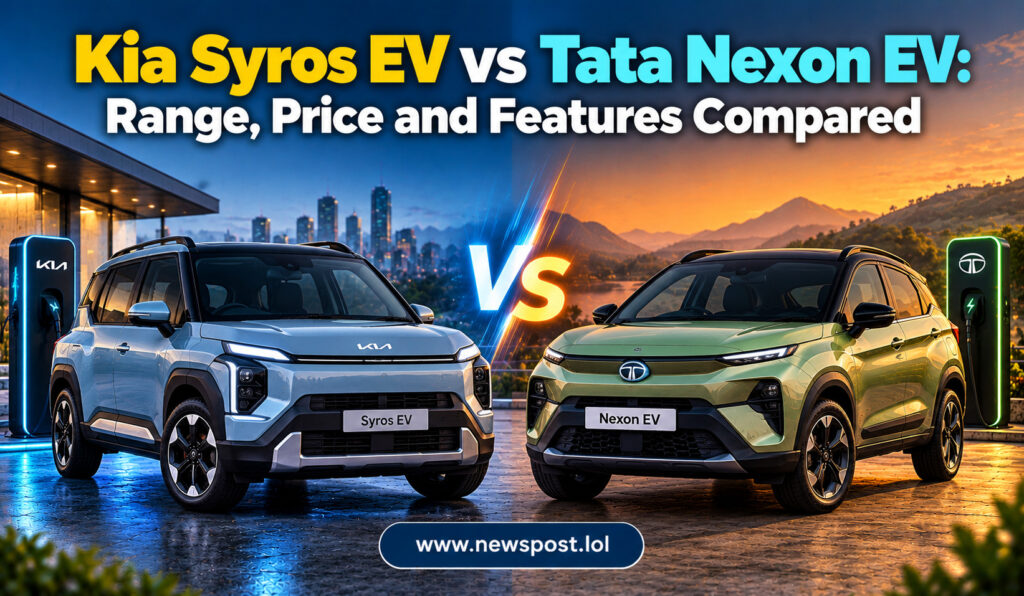

The Indian electric SUV market is becoming increasingly competitive, with manufacturers offering more battery choices, improved driving ranges and advanced cabin technology. Two models attracting attention are the Kia Syros EV and Tata Nexon EV. Both target buyers looking for a practical electric SUV for everyday commuting, family travel and occasional highway journeys, but they approach the segment differently.
The Kia Syros EV focuses on cabin space, premium features and a longer claimed range, while the Tata Nexon EV offers a more accessible starting price and two battery options. If you are planning to buy an electric SUV in India, understanding their differences in price, battery capacity, performance, charging and comfort can help you make a better decision.
Kia Syros EV vs Tata Nexon EV: Price in India
The Tata Nexon EV has a lower starting price than the Kia Syros EV, making it an attractive option for buyers entering the electric SUV market.
The Kia Syros EV is priced between approximately ₹13.50 lakh and ₹20 lakh (ex-showroom), depending on the battery and variant. It is available in HTK, HTK+, HTX, HTX+ and X-Line trims, with extended-range versions carrying the larger battery pack. Kia also offers a Battery-as-a-Service (BaaS) option on eligible versions, which reduces the initial vehicle price but adds a usage-based battery rental charge.
The Tata Nexon EV is priced at approximately ₹12.49 lakh to ₹17.89 lakh (ex-showroom), depending on the variant and battery configuration. Its range of trims includes options for buyers who want essential electric SUV features as well as those looking for a more premium equipment package.
The Nexon EV is more affordable at the entry level and also has a lower-priced top-end option. The Syros EV, however, justifies its higher positioning with a larger battery option, additional cabin space and a broader premium feature package.
Prices can change with variant updates, offers and location-specific charges, so buyers should confirm the latest ex-showroom and on-road quotations before booking.
Battery Capacity and Driving Range Compared
Driving range is one of the most important factors when choosing an electric vehicle. Both SUVs offer two battery options, but the Kia Syros EV has an advantage in claimed range.
The Kia Syros EV comes with 42kWh and 51.4kWh battery packs. The smaller battery version has a claimed range of 443km, while the larger battery offers up to 526km on the ARAI test cycle.
The Tata Nexon EV is available with 30kWh and 45kWh battery packs. Its claimed ranges are 275km and 489km, respectively, under the applicable MIDC test cycle.
This gives the Syros EV a noticeable advantage on paper, particularly when comparing the larger battery versions. Its 526km claimed range is higher than the Nexon EV’s 489km figure. The smaller Syros battery also offers a higher claimed range than the entry-level Nexon EV battery.
However, buyers should remember that the two manufacturers’ certified figures may involve different test-cycle conditions. Real-world range depends on driving speed, traffic, temperature, road conditions, air-conditioning use and driving habits. A test drive and an understanding of your daily travel distance are more useful than relying only on brochure figures.
Motor Performance and Driving Experience
The Kia Syros EV uses a single front-mounted electric motor with two output configurations. The 42kWh version produces 135hp and 255Nm of torque, while the 51.4kWh version develops 171hp and 255Nm.
The Tata Nexon EV also uses a single front-mounted electric motor. The 30kWh version produces approximately 129hp and 215Nm, while the 45kWh version produces around 144hp and 215Nm.
On paper, the Syros EV offers higher power and torque figures in both battery configurations. This can make it attractive to buyers who want stronger acceleration and confident overtaking performance.
Both vehicles deliver the immediate torque response associated with electric motors. Unlike petrol-powered SUVs, they do not need conventional multi-speed gear changes, which helps provide smooth acceleration in city traffic.
This difference in power delivery is also interesting when comparing electric cars with petrol motorcycles. The riding experience of conventional motorcycles varies considerably depending on engine character, torque delivery and gearing. This is explored in Royal Enfield vs KTM different approaches to motorcycle performance. Electric SUVs follow another approach, using motor response and electronic power management to deliver acceleration without traditional engine revving.
Charging Speed and Battery Convenience
Charging infrastructure and charging time can influence the everyday ownership experience of an electric SUV.
The Kia Syros EV supports DC fast charging at up to 100kW. Kia claims that its larger 51.4kWh battery can charge from 10 to 80 per cent in approximately 39 minutes under suitable conditions using a compatible fast charger. It also offers AC charging options, including a 7.4kW charger.
The Tata Nexon EV supports DC fast charging at up to 60kW. Tata quotes a 10 to 80 per cent charging time of approximately 40 minutes with a compatible 60kW DC charger for the 45kWh version. Its 7.2kW AC home-charging option can charge the larger battery from 10 to 100 per cent in around 6 hours and 36 minutes.
The Syros EV has a higher maximum DC charging capacity, but actual charging speed depends on charger availability, battery temperature and the vehicle’s charging curve. For people who mostly charge at home, AC charging compatibility and installation costs may matter more than the maximum DC charging figure.
Interior Space, Comfort and Practicality
The Kia Syros EV places considerable emphasis on cabin space and passenger comfort. It measures 3,995mm in length, 1,805mm in width and 1,670mm in height, with a 2,550mm wheelbase.
The Tata Nexon EV has the same overall length of 3,995mm but is slightly narrower and shorter. It measures 1,802mm in width and 1,625mm in height, with a 2,498mm wheelbase.
The Syros EV’s longer wheelbase and taller body help create a more spacious cabin. It also offers a reported 465-litre boot, compared with the Nexon EV’s 350-litre luggage capacity. This can make a difference for families carrying suitcases, shopping bags or other travel essentials.
The Syros EV also carries over the sliding, reclining and ventilated rear seats from its petrol-powered counterpart. These features give rear passengers greater flexibility and comfort. The front seats are powered and ventilated on selected higher variants.
The Nexon EV offers a practical five-seat cabin, rear AC vents, a rear armrest and ventilated front seats on selected trims. It is well suited to daily family use, although its rear-seat flexibility and boot capacity are more limited than those of the Syros EV.
Infotainment, Technology and Safety Features
Both electric SUVs offer modern infotainment systems, connected-car functions and safety equipment, but their feature combinations differ.
The Kia Syros EV gets a Trinity panoramic display layout with a 12.3-inch digital instrument cluster, a 12.3-inch central infotainment screen and a 5-inch climate-control display. Depending on the variant, equipment includes wireless Apple CarPlay and Android Auto, an eight-speaker Harman Kardon sound system, a panoramic sunroof, wireless charging, ambient lighting and a dashcam.
Higher variants also offer a 360-degree camera, Level 2 ADAS and additional convenience features. The Syros EV comes with six airbags and electronic stability control.
The Tata Nexon EV offers a digital instrument cluster and a touchscreen infotainment system, with larger displays and premium audio equipment available on selected versions. Its feature list includes wireless smartphone connectivity, connected-car technology, a panoramic sunroof, ventilated front seats and a 360-degree camera, depending on the variant. Selected top trims also offer Level 2 ADAS.
The Nexon EV comes with six airbags and electronic stability control, along with other safety and driver-assistance equipment. Buyers should compare the exact variant-wise feature lists because not every feature is available across the entire range.
Which Electric SUV Should You Buy?
The Kia Syros EV and Tata Nexon EV serve slightly different buyer requirements. The Syros EV is a stronger option for people who prioritise a longer claimed range, higher motor output, generous rear-seat space and additional premium features. Its larger battery option and faster maximum DC charging capability also make it attractive for buyers who regularly travel longer distances.
The Tata Nexon EV makes sense for buyers who want a lower starting price, a familiar compact SUV package and a choice between medium-range and long-range battery versions. Its established presence in the Indian EV market may also appeal to customers who prefer Tata’s electric vehicle ecosystem.
Before choosing either model, consider your daily driving distance, home-charging arrangements, local public charging network, family space requirements and total ownership cost.
Overall, the Kia Syros EV has an advantage in claimed range, power and cabin practicality, while the Tata Nexon EV remains a more affordable choice. The better option ultimately depends on whether your priority is a feature-rich long-range electric SUV or a value-focused EV for everyday travel.