
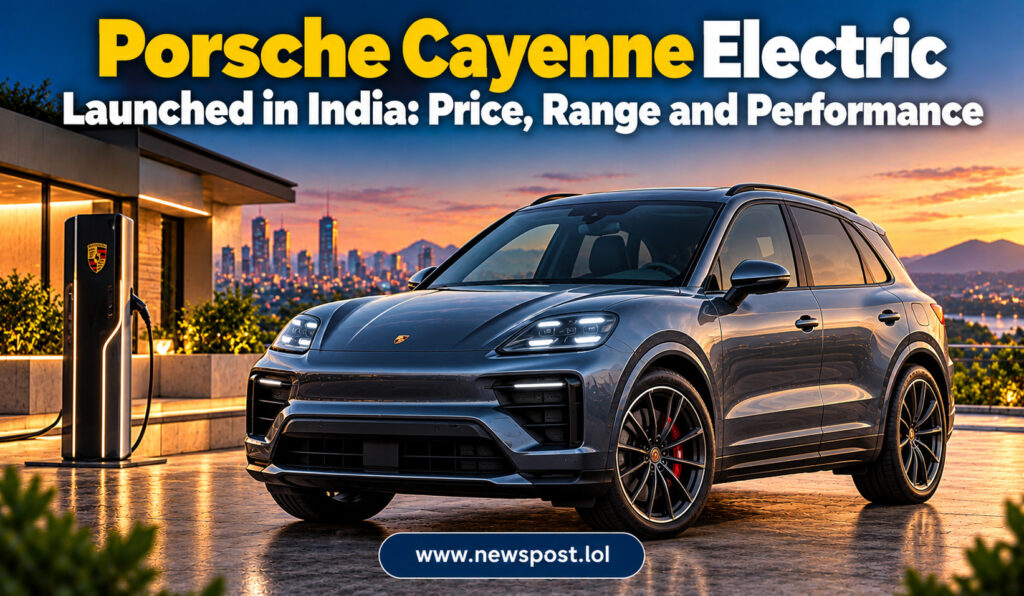

Porsche has brought its iconic Cayenne SUV into the electric era with the launch of the Porsche Cayenne Electric in India. Combining the practicality of a luxury SUV with the instant acceleration of an all-electric powertrain, the new model is designed for buyers who want premium comfort without giving up high-performance driving. It is available in two versions: the standard Cayenne Electric and the more powerful Cayenne Turbo Electric.
The India launch took place on 30 September 2026, with deliveries beginning on the same day. Both versions feature a large battery, dual electric motors and all-wheel drive. The Turbo variant takes performance to another level, offering acceleration figures usually associated with high-performance sports cars.
Here is a closer look at the Porsche Cayenne Electric price in India, battery capacity, claimed driving range, charging technology, performance and features.
Porsche Cayenne Electric Price in India and Variants
Porsche has introduced the electric Cayenne in two variants, targeting different luxury EV buyers. The standard model focuses on a balance of performance, range and everyday usability, while the Turbo Electric is aimed at customers who want substantially higher power and faster acceleration.
The ex-showroom prices are:
- Porsche Cayenne Electric: ₹1,77,27,000
- Porsche Cayenne Turbo Electric: ₹2,27,51,000
These prices are before optional equipment and personalisation choices. Porsche offers an extensive range of customisation options, so the final price can increase depending on the selected exterior finish, interior materials, wheels and additional equipment.
The electric Cayenne does not replace the petrol-powered model. Porsche has confirmed that combustion-engine versions will continue to be part of its lineup, giving customers a choice between traditional and fully electric powertrains.
Battery Capacity and Porsche Cayenne Electric Range
Both Indian variants use a 113kWh battery pack and a dual-motor electric setup. The battery is part of the Volkswagen Group’s Premium Platform Electric (PPE) architecture, which uses an advanced 800-volt electrical system.
The claimed WLTP range differs between the two versions. The standard Cayenne Electric offers up to 642km, while the Cayenne Turbo Electric has a claimed range of up to 623km on a full charge.
The slightly lower range of the Turbo is understandable because its more powerful motors and performance-focused setup prioritise acceleration and driving capability. Actual range will depend on speed, driving style, temperature, road conditions, passenger load and the use of climate control.
For Indian buyers, the claimed range makes the Cayenne Electric suitable for both regular city journeys and longer intercity travel, provided charging stops are planned. However, WLTP figures should not be treated as guaranteed real-world driving distances.
Porsche Cayenne Electric Performance and Acceleration
Performance is one of the biggest reasons the electric Cayenne stands out. Both versions use two electric motors, one on each axle, providing all-wheel drive as standard.
The standard Cayenne Electric produces 408hp and 750Nm of torque in its normal operating mode. With Launch Control activated, output rises to 442hp and 835Nm. Porsche claims a 0-100kmph acceleration time of 4.8 seconds with Launch Control, while its top speed is 230kmph.
The Turbo Electric takes things considerably further. It produces 857hp and 1,360Nm in its standard performance setting. With Launch Control, the output increases to 1,156hp and 1,500Nm. This allows the SUV to accelerate from 0 to 100kmph in a claimed 2.5 seconds and reach a top speed of 260kmph.
These figures show how electric power delivery can transform a large luxury SUV. Electric motors deliver strong torque almost immediately, helping the vehicle accelerate rapidly without conventional gear changes.
The Turbo also receives performance-focused hardware, including advanced suspension and braking technology, to help manage its much higher output. It is not simply a more powerful version; it is engineered for a more intense driving experience.
Charging Technology and Battery Support
The Cayenne Electric uses an 800V architecture designed to support high-speed charging. Under suitable conditions, it can accept DC fast-charging power of up to 390kW.
Porsche quotes a 10 to 80 per cent charging time of approximately 16 minutes when connected to a compatible high-power DC charger. This can make long-distance travel more convenient by reducing the time spent at charging stops.
The SUV also supports AC charging at up to 22kW. A full charge can take approximately 5.75 hours using a suitable AC charging setup, although actual times depend on the charger and electrical supply.
Another interesting technology is optional Porsche Wireless Charging. The system uses a charging plate installed on the floor, allowing the vehicle to charge inductively when parked in the correct position above it. It supports charging at up to 11kW.
For Indian owners, the availability of compatible high-power charging infrastructure will be an important consideration. The maximum charging speed is only achievable when the charger, battery temperature and charging conditions allow it.
Exterior Design and Dimensions
The Porsche Cayenne Electric retains the familiar proportions of the Cayenne SUV but introduces a design developed around its electric powertrain. The front features Matrix LED headlamps with Porsche’s distinctive four-point daytime running light signature. The bumper gets a clean appearance, with a wide air intake and vertically positioned air-intake elements.
The side profile features a sloping roofline, frameless doors and flush design elements. The rear is highlighted by a wraparound LED light bar with an illuminated Porsche lettering detail. These styling elements give the electric model a recognisable identity while maintaining its connection with the existing Cayenne family.
The SUV measures approximately 4,985mm in length, 1,980mm in width and 1,674mm in height. Its 3,023mm wheelbase helps create space for passengers and the battery system.
Practicality is also part of the package. The Cayenne Electric offers a 90-litre front storage compartment, commonly called a frunk, along with 781 litres of rear boot space. Folding the rear seats increases the luggage capacity to 1,588 litres.
Interior, Infotainment and Comfort Features
The cabin combines digital technology with the premium materials and customisation expected from Porsche. The dashboard features a 14.5-inch curved OLED central touchscreen and a 14.25-inch digital instrument display. Buyers can also opt for a 14.9-inch passenger display.
The centre console uses a pass-through design, creating additional storage space and housing a wireless charging area. Ambient lighting with multiple colour choices adds to the cabin atmosphere.
Standard equipment includes heated and eight-way electrically adjustable front seats, a panoramic sunroof, four-zone automatic climate control, a powered tailgate and powered rear sunshades. A 10-speaker audio system and 360-degree camera are also included.
The SUV also offers advanced driver assistance technology and a cabin air purification system. Buyers can personalise several elements, including interior trims, upholstery, exterior colours and wheel designs.
The overall cabin layout aims to make the Cayenne Electric suitable for daily use as well as long-distance journeys. Its large boot and spacious seating arrangement add to its appeal as a family-oriented luxury SUV.
Porsche Cayenne Electric: Should You Consider It?
The Porsche Cayenne Electric brings together long-distance electric mobility, premium cabin comfort and impressive performance. Its 113kWh battery, claimed WLTP range of up to 642km and fast-charging capability make it a significant addition to India’s luxury EV market.
The standard variant should appeal to buyers who want a powerful electric SUV with a more balanced approach to performance and range. The Turbo Electric is aimed at enthusiasts who prioritise acceleration and higher output, with its 1,156hp Launch Control figure making it an especially striking offering.
However, the starting price places both versions firmly in the premium luxury category. Buyers should consider charging access, ownership costs, insurance, optional equipment and the availability of high-speed charging facilities before making a decision.
Overall, the Porsche Cayenne Electric offers a new way to experience the Cayenne name. It combines the everyday usability of a luxury SUV with the instant response and performance potential of electric power, making it one of the most notable premium electric SUV launches in India in 2026.