
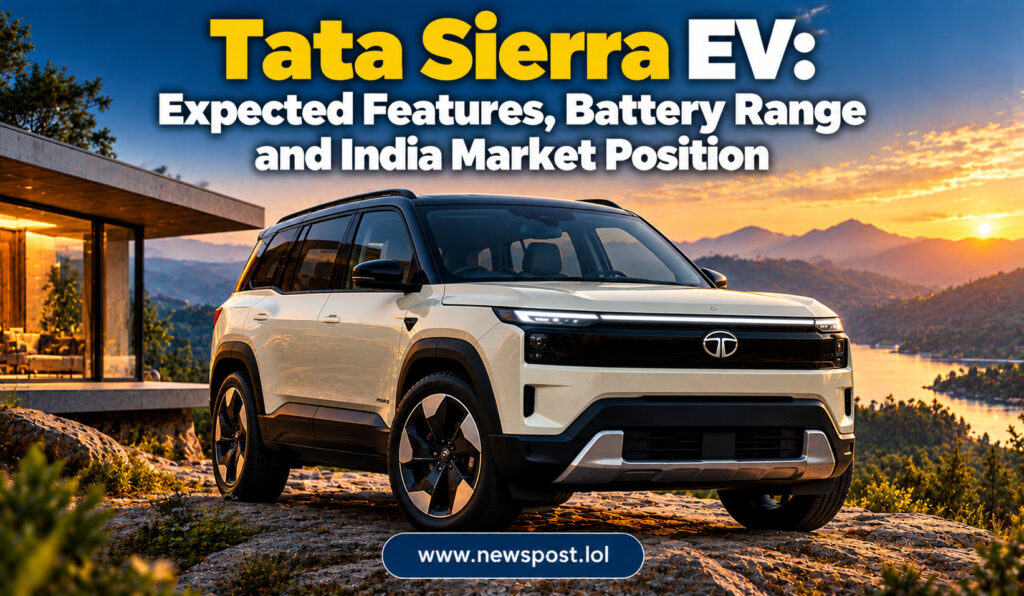

The Tata Sierra EV is an important addition to Tata Motors’ electric vehicle portfolio, bringing back the iconic Sierra name in an all-electric SUV. Combining a distinctive design, modern cabin technology, multiple battery options and an available all-wheel-drive system, the Sierra EV targets buyers looking for a practical electric SUV with a premium experience.
Although it was initially expected to launch during the first half of 2026, Tata Motors introduced the Sierra EV in India on June 30, 2026. It is positioned between the Curvv EV and Harrier EV, targeting customers who want more space and road presence than a compact electric SUV without moving into the larger and more expensive segment.
With its battery options, claimed driving range and feature-rich cabin, the Sierra EV has the potential to become an important model in India’s growing electric SUV market.
Tata Sierra EV: Price and Positioning in India
The Tata Sierra EV was launched at a starting ex-showroom price of ₹18.79 lakh, with the top-end variant priced at ₹25.99 lakh. It is offered in multiple trims, including Pure, Pure S, Adventure, Empowered and Empowered A, with battery and drivetrain availability varying by variant.
The SUV occupies an important position in Tata’s electric vehicle lineup. The Curvv EV is aimed at buyers interested in a stylish electric SUV with a coupe-inspired design, while the larger Harrier EV focuses on customers looking for a more premium and spacious vehicle. The Sierra EV sits between these two models, offering a combination of traditional SUV styling, everyday practicality and electric performance.
Its pricing places it in competition with the Mahindra BE 6, Hyundai Creta Electric, MG ZS EV, Maruti Suzuki e Vitara and VinFast VF6. The Sierra EV’s familiar nameplate and established Tata EV ecosystem could help it attract buyers considering their first electric SUV.
Tata Sierra EV Battery Options and Driving Range
Battery capacity and driving range are among the most important considerations when choosing an electric vehicle. Tata offers the Sierra EV with two battery pack options: 63kWh and 75kWh.
The 63kWh battery is available with a single rear-mounted electric motor producing 238hp and 315Nm of torque. This configuration has a claimed MIDC range of approximately 535km, according to Autocar India’s published specifications.
The larger 75kWh battery is offered with a rear-wheel-drive configuration as well as a dual-motor all-wheel-drive option. The 75kWh rear-wheel-drive version produces 209hp and 315Nm of torque, with a claimed MIDC range of up to 665km.
The dual-motor AWD version adds an electric motor at the front, producing a combined torque output of 504Nm. Its claimed MIDC range is 624km. With Boost Mode activated, Tata claims that the AWD version can accelerate from 0 to 100kmph in approximately 5.8 seconds.
These figures are based on the MIDC testing cycle and should not be confused with everyday driving range. Actual distance covered on a full charge depends on traffic, driving speed, temperature, road conditions, air-conditioning use and driving style.
Charging Technology and Electric Vehicle Convenience
Charging convenience is another important part of the Sierra EV ownership experience. The SUV supports AC home charging and DC fast charging, allowing owners to select a charging method according to their daily requirements.
With a compatible 120kW DC fast charger, Tata claims that the battery can charge from 20% to 80% in approximately 26 minutes. The company also claims that fast charging can add up to 263km of driving range in 15 minutes under suitable conditions.
For home charging, a 7.2kW AC wallbox is available. Tata’s published charging estimates indicate that a 10% to 100% charge takes approximately 8.9 hours for the 63kWh battery and 10.5 hours for the 75kWh version.
The Sierra EV also supports Vehicle-to-Load (V2L) and Vehicle-to-Vehicle (V2V) functionality. V2L allows the vehicle to supply electricity to compatible external appliances, while V2V can transfer power to another electric vehicle. These capabilities add flexibility during outdoor activities and certain emergency situations.
Exterior Design and SUV Styling
The Sierra EV retains much of the familiar design identity associated with the Sierra name. However, it receives several styling changes to distinguish it from the petrol and diesel versions.
At the front, the electric SUV features a redesigned fascia with a body-coloured closed-off section and modern LED lighting. The bumper also receives EV-specific styling details. Its side profile maintains the upright SUV proportions, while the rear design remains largely similar to the conventional Sierra.
Depending on the variant, the Sierra EV is equipped with 18-inch or 19-inch alloy wheels. Its approximately 205mm ground clearance gives it a traditional SUV stance and can be useful on uneven roads.
The overall styling is intended to appeal to buyers who prefer a conventional SUV silhouette rather than a coupe-inspired electric vehicle. This could be an advantage for customers who associate an SUV with a commanding seating position and practical proportions.
Interior, Infotainment and Comfort Features
The cabin is one of the key attractions of the Sierra EV. Its dashboard design combines a modern digital layout with features intended to make everyday driving more convenient.
Higher variants offer a triple-screen arrangement comprising a 12.3-inch central infotainment touchscreen, a 10.25-inch digital instrument cluster and a 12.3-inch passenger display. The screens provide access to entertainment, vehicle information and connected features.
Other available equipment includes a panoramic sunroof, powered and ventilated front seats, dual-zone climate control, ambient lighting and a powered tailgate. A 12-speaker JBL Black sound system is offered in selected variants, while a cabin air purifier adds another comfort feature.
The SUV also offers a head-up display, digital key, connected car technology and over-the-air software updates in selected configurations.
Practicality is another important consideration. The Sierra EV offers approximately 622 litres of boot capacity when measured up to the roof, or 450 litres up to the parcel shelf. Folding the rear seats increases the available luggage space to around 1,257 litres.
Safety and Driver Assistance Technology
Safety technology plays an important role in the Sierra EV’s premium positioning. Tata has equipped the SUV with six airbags as standard, along with electronic safety and driver-assistance features.
Selected variants offer Level 2 Advanced Driver Assistance Systems (ADAS). These systems can support the driver through functions such as adaptive cruise control, lane assistance and collision-related warnings or interventions, depending on the specific configuration.
Other available safety and convenience equipment includes a 360-degree camera, parking assistance, electronic stability control and multiple parking sensors.
The AWD variant also receives a 540-degree camera system that provides a surround view with an underbody perspective. This can be particularly useful when navigating obstacles or uneven surfaces.
The availability of individual features varies by trim. Buyers should therefore check the variant-wise equipment list rather than assuming every feature is included across the range.
Tata Sierra EV’s Position Against Rivals
The Sierra EV enters a competitive electric SUV segment where buyers have several alternatives. The Mahindra BE 6 targets customers interested in performance-oriented electric driving and distinctive styling. The Hyundai Creta Electric focuses on familiar SUV practicality and urban usability, while the MG ZS EV appeals to customers looking for a technology-focused electric SUV.
The Maruti Suzuki e Vitara also competes for buyers seeking an established brand’s electric SUV offering.
Within Tata’s own portfolio, the Sierra EV has a different role from the Curvv EV and Harrier EV. Its upright styling and spacious cabin distinguish it from the coupe-inspired Curvv EV, while its positioning below the Harrier EV can make it attractive to buyers who want a larger SUV without moving into the higher price bracket.
Its 75kWh battery, optional AWD system, long claimed MIDC range and V2L/V2V functionality are important selling points.
Is the Tata Sierra EV Worth Considering?
The Tata Sierra EV brings together a recognisable SUV design, multiple battery options, modern cabin features and an available dual-motor AWD configuration. Its claimed MIDC range of up to 665km in the 75kWh rear-wheel-drive version gives it a strong headline specification, while the AWD variant adds performance and additional traction.
For buyers considering an electric SUV in the ₹19 lakh to ₹26 lakh price bracket, it offers an interesting balance of space, technology and driving capability.
However, the final buying decision should depend on real-world range, charging access, variant-specific features and after-sales support. Autocar India’s real-world test of the AWD model recorded approximately 437–438km under its test conditions, illustrating why certified range figures should not be treated as everyday guarantees.
Overall, the Sierra EV strengthens Tata Motors’ position in India’s electric SUV market. Its combination of familiar styling, practical space and electric technology makes it a noteworthy option for customers planning to move from a conventional SUV to an electric vehicle.