
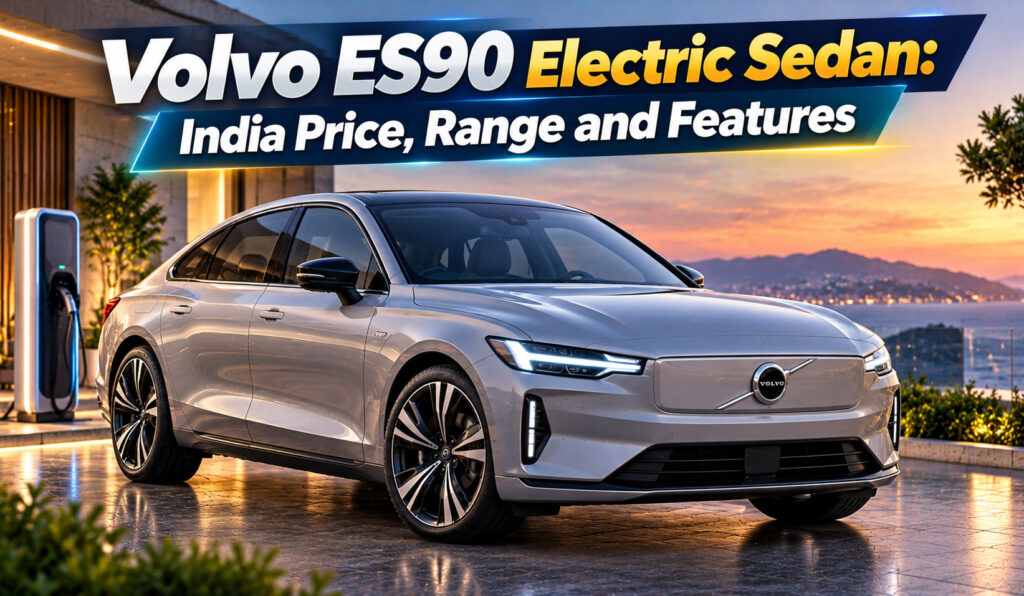

The Volvo ES90 is an all-electric luxury sedan designed to combine Scandinavian styling, advanced safety technology, long-distance driving capability and premium cabin comfort. Positioned as a flagship electric model, it brings together the practicality of a traditional four-door sedan and the technology of Volvo’s latest electric vehicle platform.
For Indian buyers, the ES90 is particularly interesting because it represents Volvo’s return to the luxury sedan segment following the discontinuation of the S90. It is expected to compete with premium electric cars such as the BMW i5, Mercedes-Benz EQS and other high-end electric sedans.
Volvo had announced plans to introduce the ES90 in India on October 12, 2026. However, as of October 30, 2026, a confirmed India-specific price and complete variant specification sheet could not be independently verified. Here’s what prospective buyers should know about its expected pricing, international specifications, driving range and features.
Volvo ES90 Price in India: What to Expect
The Volvo ES90 is expected to occupy the premium luxury electric sedan category in India. Industry estimates place its expected ex-showroom price between ₹1 crore and ₹1.20 crore. The final price will depend on the variant, equipment package, import duties and other applicable costs.
The ES90 is expected to arrive as a completely built unit (CBU), which could influence its final pricing. Buyers should also account for insurance, registration charges and other on-road expenses when calculating the overall purchase budget.
It is important to distinguish estimated pricing from an official manufacturer announcement. Prospective customers should confirm the latest price and availability with Volvo Cars India or an authorised dealership before making a booking decision.
Volvo ES90 Battery, Range and Electric Performance
One of the biggest attractions of the Volvo ES90 is its long-range electric powertrain. The sedan is developed on Volvo’s SPA2 platform, which also supports the EX90 electric SUV. Its 800-volt electrical architecture is designed to support high-speed charging and efficient power delivery.
Internationally, Volvo offers the ES90 with two battery configurations: a 92kWh battery and a larger 106kWh battery. The available powertrain depends on the market and variant.
The 92kWh version uses a single rear-mounted electric motor producing 333hp and 480Nm of torque. It can accelerate from 0 to 100kmph in approximately 6.6 seconds and offers a claimed WLTP range of up to 664km.
The larger 106kWh battery is available with dual-motor all-wheel drive. The standard Twin Motor configuration produces 456hp and 670Nm of torque, while the Twin Motor Performance version delivers up to 680hp and 870Nm. The performance variant can accelerate from 0 to 100kmph in around four seconds.
The 106kWh versions offer a claimed WLTP range of approximately 690–696km, depending on the configuration. These are international certification figures and should not be treated as confirmed Indian driving-range figures. The final India-spec battery, motor configuration and certified range need to be checked against Volvo’s official specifications.
Volvo ES90 Charging Technology
The ES90’s 800V electrical architecture is another important part of its technology package. It supports DC fast charging at up to 350kW under suitable conditions.
Volvo’s published international specifications indicate that the battery can charge from 10% to 80% in approximately 22 minutes when connected to a compatible high-power DC charger. The actual charging time can vary depending on battery temperature, charger output, charging conditions and the vehicle’s state of charge.
The car also supports AC home charging. Charging through a residential wallbox is generally more convenient for everyday use, although a full charge takes considerably longer than a DC fast-charging session.
For Indian customers, the availability of compatible high-capacity public charging stations will be an important consideration. Buyers should check charging options along their regular routes and confirm the charging equipment supplied or supported with the India-spec vehicle.
Exterior Design: A Modern Luxury Electric Sedan
The Volvo ES90 follows the brand’s minimalist Scandinavian design philosophy. Its exterior combines familiar Volvo styling elements with aerodynamic details developed for an electric vehicle.
At the front, the sedan features the signature Thor’s Hammer LED lighting design and a closed-off front fascia. The absence of a conventional engine grille gives it a distinctive electric-car appearance.
Its fastback-inspired roofline creates a flowing profile while maintaining the proportions of a luxury sedan. At the rear, C-shaped LED tail-lamps and a cleanly styled boot area contribute to its modern appearance.
Aerodynamics are another important part of the ES90’s engineering. Volvo quotes a drag coefficient of approximately 0.25, making it one of the brand’s most aerodynamically efficient production cars. International configurations offer alloy wheels ranging from 20 to 22 inches.
The overall design is aimed at buyers who prefer an understated luxury vehicle rather than an aggressively styled performance car.
Interior, Comfort and Technology Features
Inside, the Volvo ES90 focuses on space, comfort and a technology-led dashboard. Its cabin follows a minimalist layout with a floating centre console, premium materials and a large portrait-oriented infotainment display.
A 14.5-inch central touchscreen manages the infotainment system and several vehicle functions. The interface uses Google-based software and supports connected services, while 5G connectivity and over-the-air updates are part of the international technology package.
The sedan also features a 9-inch digital driver display and a 13.2-inch head-up display in its international specification. These screens provide access to driving information, navigation and vehicle-related details.
Comfort equipment can include four-zone climate control, a panoramic glass roof, wireless phone charging, a digital key, ambient lighting and a powered tailgate. The front seats offer electric adjustment, with heating, ventilation and massage functions available in selected configurations.
For audio, international versions offer a Bose sound system, while a 25-speaker Bowers & Wilkins system is available in selected markets and configurations. The exact equipment offered in India should be confirmed separately.
Cabin Space and Practicality
Although the ES90 has a sleek exterior profile, it is designed to provide a comfortable experience for both front and rear passengers. Its long wheelbase supports a spacious cabin, while the five-seat layout makes it suitable for families and business users.
International specifications list a 424-litre boot capacity with the rear seats in place. Folding the rear seats increases the available luggage space, while a 27-litre front storage compartment provides additional room for smaller items.
The ES90’s combination of rear passenger comfort, luggage capacity and electric powertrain makes it a practical alternative to some traditional luxury sedans. However, buyers should examine the rear-seat layout and boot space in person before deciding whether it meets their travel requirements.
Safety and Driver Assistance Technology
Safety remains an important part of Volvo’s identity, and the ES90 uses a combination of sensors, cameras and software to support its driver-assistance systems.
Its international technology package includes cameras, radar units, ultrasonic sensors and LiDAR hardware. These systems help the vehicle monitor its surroundings and support advanced driver assistance functions.
Depending on the market and configuration, the ES90 can offer features such as adaptive cruise control, lane assistance, collision avoidance technology, parking assistance and a 360-degree camera.
The vehicle’s software-defined architecture also supports over-the-air updates, allowing compatible software functions to be improved after purchase.
However, the availability of individual safety features and their operating conditions can differ between countries. Buyers should check the final India-spec equipment list rather than assuming that every international feature will be included.
Volvo ES90 Rivals in India
The Volvo ES90 will enter a competitive luxury electric vehicle market. The BMW i5 is one of its relevant rivals, offering a premium electric sedan experience with a focus on comfort and driving dynamics.
The Mercedes-Benz EQS is another alternative for buyers looking at a larger, technology-focused luxury electric car. The BMW i7 may also attract customers seeking a flagship electric sedan with an emphasis on rear-seat comfort.
The ES90’s potential strengths include its understated styling, long claimed WLTP range, 800V charging architecture and Volvo’s focus on safety. Its final competitiveness will depend on Indian pricing, equipment, after-sales support and the charging experience available to customers.
Is the Volvo ES90 Worth Considering?
The Volvo ES90 could be an interesting choice for buyers looking for a premium electric sedan with long-distance potential, advanced technology and a comfortable cabin. Its international 106kWh configuration offers up to 696km of claimed WLTP range, while the 800V architecture supports high-speed DC charging.
However, Indian buyers should wait for confirmation of the final price, battery configuration, certified range and feature list. Charging infrastructure, insurance costs and the availability of service support should also form part of the purchase decision.
If Volvo positions the ES90 competitively in India, it could become an attractive alternative to established luxury electric sedans. Its success will ultimately depend on how well the India-spec model balances price, range, comfort and ownership experience.