
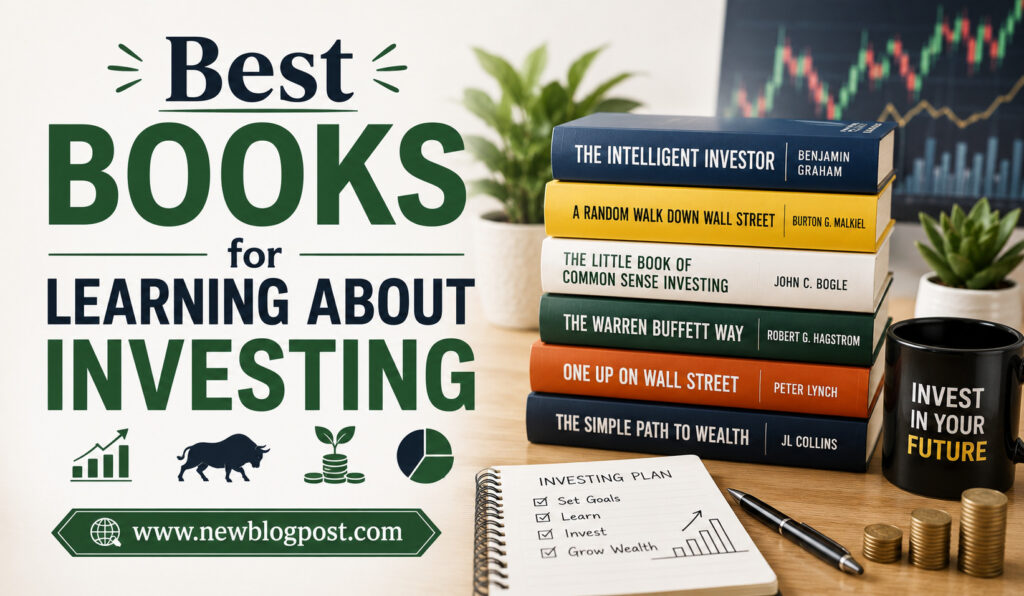

Investing can seem complicated when you first encounter terms such as stocks, bonds, index funds, dividends, diversification, valuation, and market volatility. With countless financial products and opinions available online, beginners can easily become confused about where to start.
A good investing book can provide something that short online articles often cannot: a structured way to understand the subject. The right book can explain how markets work, why prices change, how investors manage risk, and why patience is often more important than trying to predict every market movement.
The best books for learning about investing are not necessarily the ones promising spectacular returns. Instead, they help readers develop sound principles, understand risk, think independently, and make decisions based on long-term goals.
Whether you are completely new to investing or already understand the basics, the following books can help strengthen your financial knowledge.
Why Books Are Useful for Learning About Investing
Investing is a subject where context matters. Learning that a stock can rise or fall is easy. Understanding why diversification matters, how valuation affects decisions, and how emotions influence investors takes more time.
Books allow authors to explore these ideas in greater depth. They can explain concepts through examples, stories, historical situations, and detailed frameworks.
A strong investing education should help you understand not only what investors do, but why they do it.
For beginners, useful topics include:
- How financial markets operate.
- The relationship between risk and return.
- Diversification and asset allocation.
- The importance of long-term thinking.
Once these concepts become familiar, more advanced investing topics become easier to understand.
The Intelligent Investor by Benjamin Graham
The Intelligent Investor is one of the most influential books in investment literature. It focuses on disciplined investing, valuation, risk management, and the difference between investing and speculation.
One of its most important lessons is that markets can be influenced by emotion. Prices may move significantly even when the underlying businesses have not changed to the same extent.
The book encourages investors to think about the value of an investment rather than simply following market enthusiasm.
Although some examples and market references reflect an older financial environment, many of its underlying principles remain relevant.
For beginners, the book can introduce the idea that successful investing requires patience, discipline, and an ability to manage emotions.
A Random Walk Down Wall Street by Burton G. Malkiel
A Random Walk Down Wall Street offers a broad introduction to investing and financial markets.
The book discusses different investment approaches and explains why consistently predicting market movements can be extremely difficult.
One of its major themes is that investors should be cautious about strategies that promise easy market-beating results.
It also introduces concepts surrounding diversification and low-cost investing, making it a useful option for beginners interested in building a long-term investment strategy.
The writing is accessible enough for newcomers while covering a wide range of investment concepts.
One Up On Wall Street by Peter Lynch
One Up On Wall Street introduces readers to a more hands-on approach to investing.
Peter Lynch discusses how ordinary investors can notice interesting businesses through everyday experiences. The book encourages readers to pay attention to companies they encounter in normal life while also emphasizing the importance of proper research.
The important lesson is not that buying familiar companies automatically leads to successful investments. Rather, familiarity can be a starting point for further investigation.
This book can be especially appealing to readers who want to understand how individual companies might be evaluated.
Common Stocks and Uncommon Profits by Philip Fisher
Philip Fisher’s Common Stocks and Uncommon Profits focuses on evaluating businesses and identifying companies with strong long-term potential.
The book places considerable attention on qualitative factors. Investors are encouraged to look beyond simple financial numbers and consider areas such as management quality, business strategy, competitive position, and future growth opportunities.
This makes the book useful for readers who want to move beyond basic investing concepts and learn more about analyzing individual businesses.
It is better suited to readers who already understand some investment fundamentals.
The Psychology of Money by Morgan Housel
Although The Psychology of Money is not exclusively an investing manual, it is extremely useful for anyone learning about investing.
Investment decisions are influenced by behavior. Fear can cause people to sell during market declines, while excitement can encourage excessive risk during periods of rapid growth.
The book explores how personal experiences, expectations, and emotions shape financial decisions.
For beginners, this perspective is valuable because knowing what to buy is only part of investing. Knowing how to behave when markets become uncertain can be equally important.
The Essays of Warren Buffett
This collection brings together ideas about investing, business quality, management, valuation, and shareholder thinking associated with Warren Buffett.
Rather than functioning as a step-by-step beginner guide, it provides insight into how a long-term investor evaluates businesses and thinks about ownership.
The material can help readers understand concepts such as economic advantages, management quality, long-term value, and the importance of avoiding unnecessary speculation.
It is particularly useful after learning basic investment terminology because the ideas become easier to appreciate with some foundational knowledge.
Investing Books for Different Types of Learners
Not every beginner needs the same investing book. Your preferred approach and current knowledge should influence your choice.
| Book | Main Focus | Best For |
| The Intelligent Investor | Value and disciplined investing | Understanding investment principles |
| A Random Walk Down Wall Street | Markets and diversification | Beginners seeking a broad overview |
| The Little Book of Common Sense Investing | Index investing | Simple long-term strategies |
| One Up On Wall Street | Individual companies | Learning about stock selection |
| Common Stocks and Uncommon Profits | Business analysis | More advanced beginners |
| The Psychology of Money | Investor behavior | Understanding financial emotions |
There is no requirement to read these books in a particular order. Begin with the subject that interests you most.
What Beginners Should Understand Before Investing
Before purchasing an investment, it is useful to understand your own financial situation.
Investing should generally be considered alongside other financial priorities rather than separately from them. Your emergency savings, debt, income stability, time horizon, and financial goals can all affect the type and amount of risk that may be appropriate.
You should also understand that investments can lose value. There is no guaranteed return in normal market investing, and past performance does not guarantee future results.
Some foundational concepts worth learning include:
- Risk and return.
- Diversification.
- Compound growth.
- Investment fees and expenses.
- Time horizon and volatility.
Understanding these ideas can help prevent emotional decisions later.
Why Diversification Matters
Putting all your money into a single company, industry, or asset exposes you to concentrated risk. If that investment performs poorly, your entire portfolio may be affected.
A diversified portfolio spreads exposure across different investments. The exact structure depends on personal circumstances, goals, and risk tolerance, but the underlying principle is straightforward: avoid depending entirely on one outcome.
Diversification does not eliminate losses. Markets can decline broadly. However, spreading investments can reduce the impact of problems affecting a particular company or sector.
The Importance of Long-Term Thinking
Many beginners enter investing with the expectation that they should constantly identify the next winning investment.
This mindset can create unnecessary stress. Markets move unpredictably in the short term, and even experienced professionals can be wrong about individual predictions.
Long-term investing focuses more heavily on consistent decision-making, diversification, costs, and patience.
The longer your investment horizon, the more important it becomes to understand how short-term volatility fits into your overall strategy.
This does not mean ignoring risk. It means recognizing that temporary price movements and long-term financial goals are not always the same thing.
How to Use Investing Books Effectively
Reading several investment books without applying anything can create the illusion of progress.
Instead, keep your learning practical. When a book introduces a concept you do not understand, take time to learn the terminology before moving ahead.
Avoid rushing into investments simply because a book makes a particular strategy sound appealing.
A productive learning process might look like this:
- Learn basic financial terminology.
- Understand different investment approaches.
- Compare the risks and advantages of each approach.
- Develop a personal investment framework.
- Review your understanding before making decisions.
Investing is a long-term subject. There is no need to master everything in a single week.
Common Mistakes New Investors Should Avoid
Beginners often make mistakes because investing can trigger strong emotions. A rapidly rising market may create excitement, while a sudden decline may create panic.
Some common mistakes include:
- Investing money needed for short-term expenses.
- Following market trends without understanding the investment.
- Ignoring fees and taxes.
- Expecting guaranteed returns.
- Buying or selling purely because of fear or excitement.
A good investing education should make you more thoughtful, not more eager to make frequent trades.
Frequently Asked Questions
Is The Intelligent Investor suitable for beginners?
It can be, but some readers may find it more challenging than modern introductory investing books. Its principles are valuable, but beginners may benefit from learning basic investment terminology first.
Can I learn investing just by reading books?
Books can provide a strong educational foundation, but investing also requires understanding your personal financial situation, local regulations, taxes, and investment options. Reading should be part of a broader learning process.
Is investing the same as trading?
No. Investing generally refers to acquiring assets with a longer-term objective, while trading often involves buying and selling more frequently to benefit from shorter-term price movements. They involve different strategies, risks, and time commitments.
Final Thoughts
Learning about investing is a long-term process, and the right books can make the journey much easier. Instead of chasing complicated strategies or promises of quick profits, beginners should focus on understanding risk, diversification, costs, market behavior, and long-term decision-making.
The most valuable lesson is that investing is not simply about choosing what to buy. It is also about understanding why you are investing, how much risk you can handle, and how you will behave when markets become uncertain.
Start with the basics, learn patiently, and avoid making decisions you do not understand. The more clearly you understand investing principles, the better prepared you can be to make thoughtful financial choices for the long term.