
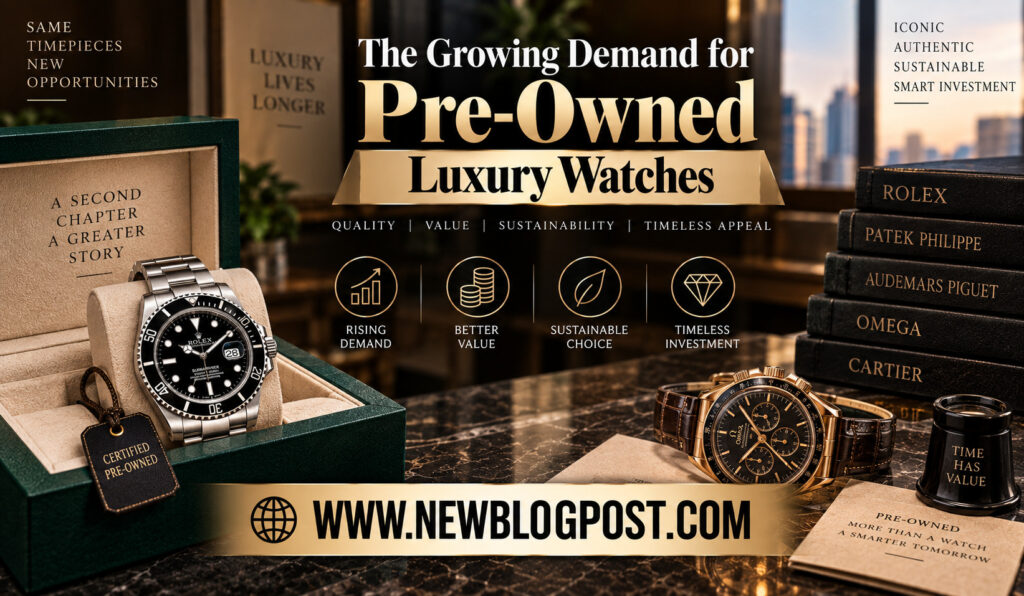

A watch that already has a previous owner used to be a hard sell. Now it might be the smarter purchase. The growing demand for pre-owned luxury watches has turned what was once a niche resale category into one of the fastest-growing corners of the entire watch industry. This guide explains what is driving that shift and what it means for buyers.
The numbers tell the story better than any single anecdote. Analysts now value the global pre-owned luxury watch market at tens of billions of dollars, with projections showing continued double-digit growth through the rest of the decade.
How Big the Pre-Owned Market Has Become
The pre-owned luxury watch market has grown from a scattered network of dealers into a sector tracked closely by major research firms.
Industry estimates place the global pre-owned luxury watch market at more than 32 billion dollars, with projections showing it could climb well past 80 billion dollars by the early 2030s. That growth rate significantly outpaces the broader luxury goods industry. Some forecasts from major consulting firms suggest the secondary market could represent a significant share of total watch industry sales within the next few years.
What started as a resale afterthought has become a distinct, investment-driven segment that brands and analysts now track on its own terms.
Why Buyers Are Turning to the Secondary Market
Several forces are pushing buyers toward pre-owned watches instead of waiting for new releases.
Long waiting lists at authorized dealers have pushed patient buyers toward the secondary market, where in-demand references are often available immediately rather than after months or years on a list. Rising prices on new releases have also made pre-owned pieces, including recent models, a more accessible entry point into major brands. Sustainability concerns play a role too, since buying a pre-owned watch avoids the environmental cost of producing something new.
- Immediate availability: no waiting list required for most pre-owned pieces.
- Lower entry cost: access to major brands without paying full retail on a new release.
- Investment appeal: certain references have a track record of holding or increasing in resale value.
- Sustainability: reusing an existing watch avoids the resource cost of new production.
Younger buyers in particular have shown strong interest in treating pre-owned watches as both a style choice and a financial decision.
The Platforms Driving the Shift
Online marketplaces have done more than almost any other factor to legitimize and grow the pre-owned watch market.
Platforms like Chrono24 now attract millions of visitors a month, connecting buyers and sellers across dozens of countries with built-in tools for verifying seller reputation. Other major players, including WatchBox and a growing number of authenticated resale specialists, have built businesses specifically around sourcing, authenticating, and reselling high-end watches. These platforms solved one of the biggest historical barriers to buying pre-owned: trust. Detailed listings, seller ratings, and in-house authentication processes have made buyers far more comfortable purchasing a watch they cannot inspect in person.
That combination of reach and trust has turned online marketplaces into a genuine alternative to authorized dealer networks, not just a fallback option.
Which Brands Dominate Resale Demand
Certain brands consistently drive the largest share of activity on the pre-owned market.
Rolex remains the single most requested brand across major resale platforms, accounting for a large share of all buyer inquiries. Omega and Cartier also see strong pre-owned demand, with a notably high percentage of Cartier shoppers specifically seeking pre-owned or vintage pieces rather than new ones. Patek Philippe’s more complicated references, including perpetual calendars and chronographs, have also seen fast-growing resale interest as collectors look beyond the brand’s best-known steel sports models.
Vintage and recently discontinued references often see the sharpest price movement, since collectors move quickly once a model is no longer available new.
What Buyers Should Know Before Purchasing
A pre-owned purchase carries a few extra considerations compared to buying new from a boutique.
- Verify authenticity through a platform’s certification process or an independent appraiser before completing a purchase.
- Check remaining warranty coverage, since some pre-owned watches still carry time left on the original manufacturer warranty.
- Ask for full service history if available, since irregular servicing can affect a watch’s long-term reliability.
- Compare prices across multiple listings for the same reference, since pricing can vary significantly between sellers.
- Confirm return policies before buying from an unfamiliar platform or private seller.
Key Takeaways
- Market size: The global pre-owned luxury watch market is valued at more than 32 billion dollars and growing quickly.
- Main drivers: Waiting lists, rising new-watch prices, investment appeal, and sustainability concerns.
- Leading platforms: Chrono24 and WatchBox have built trust through authentication and detailed seller information.
- Top brand demand: Rolex, Omega, Cartier, and Patek Philippe consistently drive the most resale activity.
- Before buying: Verify authenticity, check warranty status, and review service history.
Frequently Asked Questions
Why are pre-owned luxury watches becoming so popular?
Long waiting lists, rising new-watch prices, and growing interest in sustainability are the main forces driving demand toward the secondary market.
Is Chrono24 a trustworthy place to buy a pre-owned watch?
Yes, Chrono24 and similar established platforms use seller ratings and authentication tools to reduce the risk of buying pre-owned online.
Which brand sees the most pre-owned demand?
Rolex consistently accounts for the largest share of pre-owned buyer requests across major resale platforms.
Do pre-owned luxury watches hold their value?
Certain references, particularly from Rolex and Patek Philippe, have a strong track record of holding or increasing in resale value over time.
Is buying pre-owned cheaper than buying new?
Often yes, though highly sought-after references can sometimes sell for more than their original retail price on the secondary market.
Conclusion
The growing demand for pre-owned luxury watches reflects a genuine shift in how collectors think about buying a watch, driven by long waiting lists, rising new-watch prices, and a maturing set of trustworthy online platforms. What used to be a fallback option has become, for many buyers, the preferred way into the luxury watch world.