
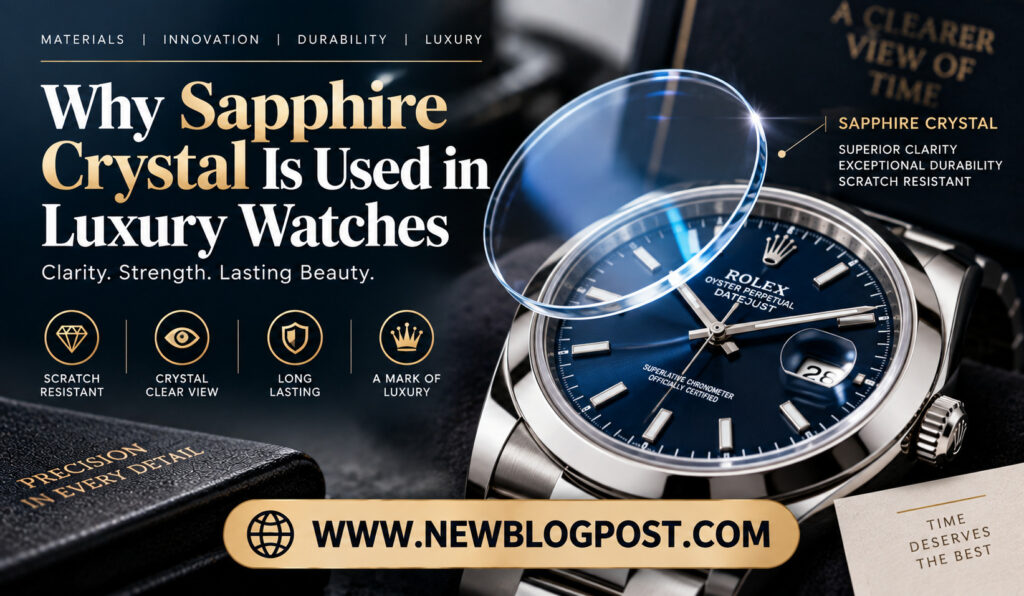

Drop a watch face-down on concrete, and the material covering the dial decides whether you walk away with a scare or a repair bill. That single detail explains why sapphire crystal is used in luxury watches almost universally today. This guide covers what the material actually is, how it compares to the alternatives, and why it became the default choice at the high end of the industry.
Despite the name, there is nothing precious or gem-like about how the material starts out.
What Sapphire Crystal Actually Is
Sapphire crystal in watchmaking has no connection to the blue gemstone people picture when they hear the word sapphire.
The material is synthetic corundum, chemically identified as aluminum oxide, grown in controlled laboratory conditions rather than mined from the earth. It shares its chemical structure with natural sapphire, but manufacturers produce it specifically for clarity and hardness rather than color. The same base material, corundum, is also used to make the tiny synthetic rubies found inside many mechanical watch movements.
Because it is grown rather than found, sapphire crystal comes out far more consistent and free of the natural inclusions that appear in mined gemstones.
How It Compares to Mineral Glass and Acrylic
Watch crystals have gone through three main eras of material, and the differences between them are significant.
Acrylic, also called plexiglass or hesalite, dominated mid-twentieth-century watchmaking. It rates only about 3 on the Mohs hardness scale, meaning it scratches easily, though those scratches can often be polished away. Mineral glass improved scratch resistance somewhat, rating around 6.5 on the same scale, but remains more brittle and prone to shattering compared to sapphire. Sapphire crystal rates a 9 on the Mohs scale, trailing only diamond, which sits at 10.
- Acrylic: scratches easily, but resists shattering and stays inexpensive.
- Mineral glass: a middle-ground option, mostly found on lower-cost watches today.
- Sapphire crystal: extremely scratch-resistant, though comparatively brittle under sharp impact.
That hardness gap explains why a sapphire crystal can survive years of daily wear against keys, countertops, and rings without a single visible scratch.
How Sapphire Crystal Is Manufactured
Producing sapphire crystal requires extreme heat and precise control over how the material cools.
Manufacturers heat powdered aluminum oxide past 2,000 degrees Celsius, forming large cylindrical crystals called boules as the material cools and solidifies. Several different manufacturing methods exist, including the Verneuil process and the Kyropoulos method, and each affects the final crystal’s clarity and internal stress. Once a boule forms, manufacturers slice it into thin discs and cut those discs into the exact shape needed for a specific watch case.
Many high-end watches also add an anti-reflective coating to the finished crystal, which can cut glare dramatically and make the dial far easier to read in bright light.
The Trade-Offs of Using Sapphire
Sapphire crystal is not without downsides, and understanding them helps explain why it did not become universal on every watch overnight.
Its extreme hardness comes paired with brittleness, meaning a sharp, direct impact can crack or shatter a sapphire crystal in situations where a mineral glass or acrylic crystal might simply flex or dent. Cutting and polishing sapphire is also far more expensive than working with softer materials, which is one reason sapphire crystal remains rare on watches priced under roughly one thousand dollars. Repairing or replacing a cracked sapphire crystal typically costs more than replacing a mineral glass equivalent.
Despite these tradeoffs, most brands and buyers consider the scratch resistance worth the added cost and slightly increased impact risk.
Why It Became the Luxury Standard
Sapphire crystal moved from an industrial and optical material into mainstream luxury watchmaking as production technology advanced through the mid-twentieth century.
By the 1970s, major brands including Rolex, Omega, and Patek Philippe had adopted sapphire crystal across their top models, setting a new expectation for durability at the high end of the market. As manufacturing costs gradually decreased, sapphire spread further down the price ladder, though it still rarely appears on the least expensive watches. Today, it functions almost as a baseline requirement for any watch marketed as a serious luxury piece, alongside a Swiss mechanical movement and quality metal casing.
A scratched crystal can make even a well-built watch look worn out quickly, which is exactly the problem sapphire was adopted to solve.
Key Takeaways
- Material: Sapphire crystal is lab-grown synthetic corundum, not a mined gemstone.
- Hardness: It rates 9 on the Mohs scale, compared to 6.5 for mineral glass and roughly 3 for acrylic.
- Main advantage: Exceptional scratch resistance that keeps a dial looking new for years.
- Main tradeoff: Greater brittleness under sharp impact compared to mineral glass or acrylic.
- Industry adoption: Major luxury brands standardized on sapphire crystal by the 1970s.
Frequently Asked Questions
Is sapphire crystal a real gemstone?
No, sapphire crystal used in watches is lab-grown synthetic aluminum oxide, not a mined gemstone.
Can sapphire crystal scratch?
It rarely scratches under normal use, since only materials as hard as diamond can typically scratch it.
Is sapphire crystal stronger than mineral glass?
It is significantly harder and more scratch-resistant, though it can be more prone to cracking under a sharp, direct impact.
Why do cheap watches not use sapphire crystal?
Sapphire is more expensive to cut and polish than mineral glass or acrylic, which keeps it less common on lower-priced watches.
Do all luxury watches use sapphire crystal?
Most modern luxury watches use sapphire crystal, though some vintage-style or budget-friendly models still use acrylic for its classic look.
Conclusion
Sapphire crystal is used in luxury watches because it solves a problem every watch owner eventually faces: keeping a dial looking new despite years of daily wear. Its lab-grown hardness, combined with decades of adoption by major Swiss brands, has turned it from a specialty material into an expected feature of any serious luxury timepiece.