

Introduction
A Rolex Daytona once owned by actor Paul Newman sold for 17.8 million dollars, a price driven almost entirely by its documented history rather than the watch alone. That single sale shows exactly why watch provenance matters to collectors, sometimes even more than the mechanics inside the case.
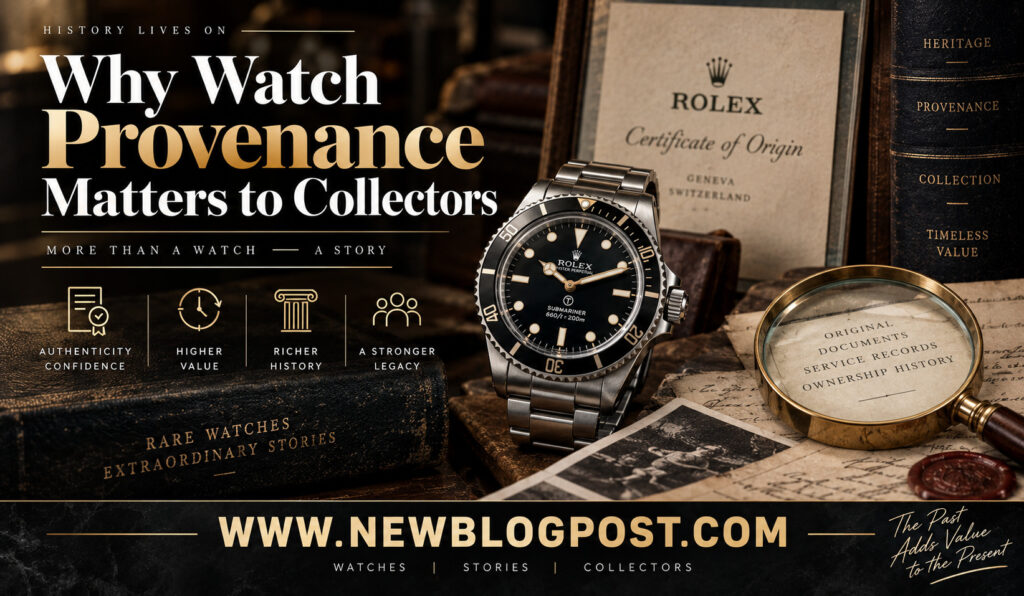
Provenance is the documented history of a watch, covering everything from its original sale to every owner and service that followed. For collectors, this paper trail can be the difference between a confident purchase and a costly mistake. This guide explains what provenance means and why it carries so much weight in the luxury watch world.
What Provenance Actually Means
Provenance refers to the verifiable history behind a specific watch, not just its brand or model.
At its core, provenance links a watch’s exact serial number to a real chain of ownership, sale dates, and service events. This record helps confirm that a watch is genuine and has not been altered beyond its original factory specification.
- Original date and location of sale
- Names of previous owners, when known and disclosed
- Any notable history, such as a connection to a public figure or event
A watch with strong provenance tells a clear, consistent story from the day it left the manufacturer to the moment it reaches a buyer today.
Box, Papers, and the Full Set
The phrase full set refers to a watch’s complete original presentation, and it plays a major role in establishing provenance.
A genuine full set typically includes the warranty card, the outer and inner boxes, hang tags, and the owner’s instruction booklet. Among these, the warranty card and original receipt tend to matter most, since they link a specific serial number to a confirmed sale date and dealer.
- Warranty card or certificate: Confirms the watch’s authenticity and original sale details.
- Original receipt: Shows exactly where and when the watch was first purchased.
- Boxes and booklets: Add completeness but generally weigh less in valuation than the paperwork itself.
Full-set watches consistently sell faster and for more money than the same reference sold without its original accessories.
Service History and Ownership Records
A documented service history adds another layer of confidence for collectors evaluating a watch.
Every time an authorised service centre works on a watch, that visit is logged. These records function as both a maintenance history and an ongoing form of authenticity verification, since they confirm the watch has been maintained through proper channels rather than an unofficial repair shop.
- Confirms the movement has not been swapped for a non-original part
- Shows whether a watch has had consistent, professional care over time
- Builds a timeline that supports the rest of the watch’s provenance story
For older or vintage pieces, even partial service records can meaningfully strengthen a buyer’s confidence.
Provenance and Authentication
Provenance and authenticity are closely related, but they are not the same thing.
Strong documentation helps confirm a watch is genuine, yet paperwork alone is never absolute proof. Convincing counterfeit watches occasionally appear with equally convincing counterfeit boxes and forged papers, which is why serious buyers still inspect the watch itself.
- Movement details, dial printing, and case finishing must match known genuine examples
- Manufacturer archive extracts, where available, offer an added layer of verification
- Reputable dealers treat documentation as supporting evidence rather than the entire case
The safest approach combines strong provenance with a hands-on inspection from someone who knows the reference well.
How Provenance Affects Resale Value
The financial impact of solid provenance is significant and well documented across the secondary market.
Watches with original box and papers typically sell for meaningfully more than identical examples without them. For popular references from brands like Rolex, Patek Philippe, and Audemars Piguet, a full set can add a noticeable premium, and that gap widens further for rare or vintage pieces.
- Full-set watches tend to sell faster than watches sold without documentation
- Buyers with full sets often receive stronger trade-in offers on future purchases
- Historically significant provenance, such as ownership by a notable figure, can multiply a watch’s value many times over
For collectors thinking about long-term value, keeping every document that comes with a watch is one of the simplest ways to protect it.
Key Takeaways
- Provenance: The documented history linking a watch’s serial number to its sale and ownership record.
- Full set: Box, papers, and booklets that support authenticity and often speed up resale.
- Service history: Confirms proper maintenance and helps rule out unauthorised parts.
- Authentication: Paperwork supports authenticity but should never replace physical inspection.
- Resale value: Strong provenance consistently adds a measurable premium on the secondary market.
Frequently Asked Questions
What is considered a full set for a luxury watch?
A full set usually includes the original box, warranty card or papers, hang tags, and the owner’s instruction booklet.
Can a watch still be valuable without its original box and papers?
Yes, a well-preserved watch with a clear history can still be desirable, though it typically sells for less than an identical example with full documentation.
Do box and papers prove a watch is authentic?
Not entirely, since forged documents do exist, so the watch itself should always be checked by someone familiar with the reference.
Why do vintage watches value provenance even more than modern ones?
Original papers from decades ago are rare, so surviving documentation adds significant historical and financial weight to older pieces.
Does service history affect a watch’s resale value?
Yes, a documented service history from an authorised centre reassures buyers that the watch has been properly maintained.
Conclusion
Provenance turns a watch from an anonymous object into a documented piece of history, and that difference shapes both trust and price across the collector market. Strong paperwork, a clear ownership trail, and a solid service history give buyers confidence and give sellers a meaningful edge at resale. For anyone serious about collecting, protecting a watch’s provenance is just as important as protecting the watch itself.