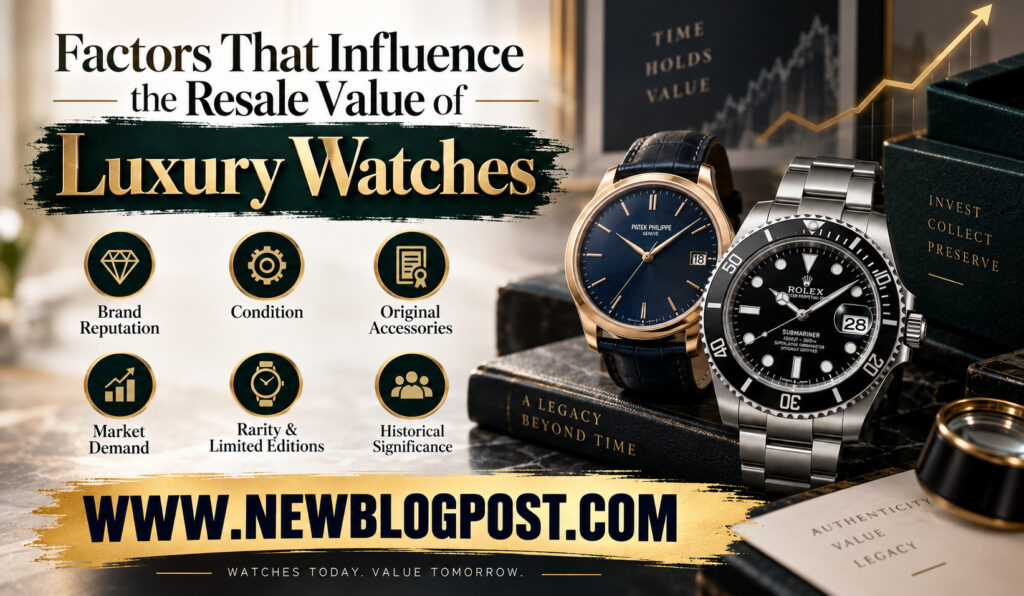

Two watches from the same brand, released the same year, can sell for very different prices on the secondary market. The gap usually comes down to a handful of specific factors that experienced buyers check before they ever look at the price tag. Understanding what influences the resale value of luxury watches helps you avoid overpaying and gives you a better shot at holding value if you ever decide to sell.
Brand and Market Factors
Before a buyer even looks closely at a specific watch, the brand behind it already sets a baseline for how much resale interest to expect.
- Brand prestige: Names like Rolex, Patek Philippe, and Audemars Piguet carry global recognition that creates a floor under resale prices.
- Supply constraint: Watches that are genuinely hard to buy new, whether through limited production or long waiting lists, tend to hold value far better than widely available models.
- Global demand versus regional demand: A watch popular only in one country will usually sell for less on the wider secondary market than one with demand across multiple regions.
- Cultural or historical tie-in: Watches connected to a famous event, athlete, or achievement often see demand spikes that support pricing for years afterward.
- Overall economic conditions: Even the strongest brands can see secondary market softening during periods of broader economic uncertainty.
Watch-Specific Design Factors
Once brand and market conditions are accounted for, the design choices baked into a specific model play a major role in how well it holds value.
- Iconic design: Shapes that have stayed recognizable for decades, such as the Submariner silhouette or the Royal Oak’s octagon bezel, carry proven long-term demand.
- Material choice: Stainless steel sports models often outperform gold or platinum versions of the exact same watch on the resale market.
- Movement type: An in-house automatic or mechanical movement generally supports stronger resale value than a basic quartz movement.
- Production numbers: A model made in a few hundred pieces holds far more weight with collectors than one labeled limited edition but produced in the thousands.
- Complications: Extra features such as a chronograph or a dual time zone function can add resale appeal, provided the added complexity does not hurt long-term reliability.
- Color and variant rarity: Certain dial colors or bezel combinations become collector favorites and can command a premium over the standard version of the same model.
Condition and Documentation Factors
Two identical watches can sell for very different amounts once you factor in how each one was cared for and what paperwork comes with the sale.
- Physical condition: Scratches, dial damage, and a worn bracelet or strap all reduce what a buyer is willing to pay.
- Documentation: A complete box, warranty card, and original papers can add a meaningful premium compared to the same watch sold without them.
- Service history: A clear, documented service record reassures buyers that the movement has been properly maintained over time.
- Originality of parts: Watches with original factory parts generally sell for more than those with replaced dials, hands, or bezels from third party sources.
- Authenticity verification: A watch that has already been checked and certified by a reputable dealer often sells faster and at a better price than one requiring the buyer to verify everything themselves.
How These Factors Work Together
None of these factors work in isolation, and the strongest resale performers tend to score well across almost every category at once.
- A Rolex Daytona, for example, combines strong brand prestige, genuine supply constraint, an iconic design, and a steel case, which together explain its consistent premium.
- A precious metal dress watch from the same brand might share the prestige factor but lack the supply constraint and steel case advantage, which explains why it often performs worse on resale.
- Buyers who understand this layered approach can make smarter choices even with lesser known models, by favoring steel over gold, complete documentation over an incomplete set, and proven designs over experimental ones.
- No single factor guarantees resale performance on its own, which is why relying on brand name alone is a common and costly mistake.
Key Takeaways
- Most important market factor: Supply constraint combined with strong brand prestige.
- Most important design factor: Iconic, long-running shapes in stainless steel rather than precious metal.
- Most important condition factor: Complete documentation, including box and papers.
- Common mistake to avoid: Assuming brand name alone guarantees strong resale value.
- Best overall strategy: Favor references that score well across brand, design, and condition factors at the same time.
Frequently Asked Questions
Does the material of a watch really affect its resale value?
Yes, stainless steel sports watches generally outperform gold or platinum versions of the same model on the secondary market.
How much does having the original box and papers matter?
A complete set with box, papers, and warranty card can add a meaningful premium compared to the same watch sold without them.
Can a watch with a large production run still hold value well?
It is less likely, since scarcity is one of the strongest drivers of resale value, though strong brand demand can still provide some support.
Does service history actually change what a watch sells for?
Yes, a documented service history reassures buyers that the movement has been properly maintained and can support a higher resale price.
Is brand name enough to guarantee a watch holds its value?
No, brand name is only one factor, and design, material, condition, and documentation all play a significant role as well.
Conclusion
The resale value of a luxury watch rarely comes down to one single reason. Brand prestige, genuine supply constraint, iconic design, material choice, and a complete documented history all combine to decide what a watch is worth years after purchase. Buyers who weigh all of these factors together, rather than focusing on brand name alone, are far better positioned to choose a watch that holds its value over time.