
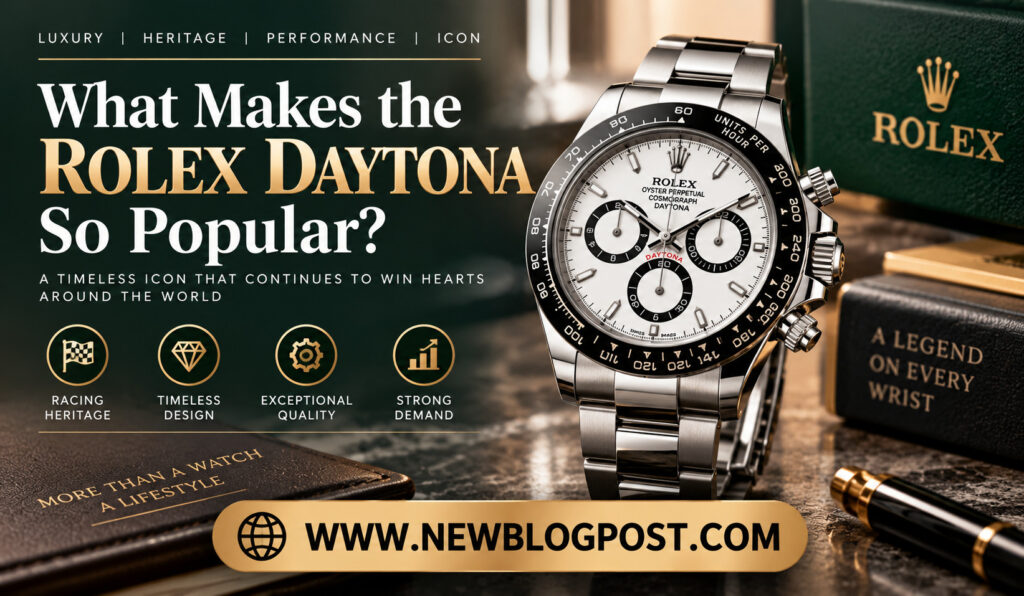

Few watches spark as much conversation as the Rolex Daytona. It shows up on wrists at car shows, in auction headlines, and in nearly every debate about which watch holds its value best. So what actually explains the obsession? The answer sits somewhere between motorsport history, brutal scarcity, and a resale market that behaves nothing like a normal luxury purchase.
A Racing Watch Born in 1963
Rolex introduced the Cosmograph Daytona in 1963, built for professional racing drivers who needed to measure speed, not just time. The name honors Daytona Beach, Florida, home of the Daytona 500 and a hub for motorsport in the mid-twentieth century.
- A tachymeter bezel lets the wearer calculate average speed over a measured distance.
- Three subdials track elapsed seconds, minutes, and hours for precise timing during a race.
- The chronograph function pairs with the same waterproof Oyster case Rolex uses across its sport models.
That racing pedigree gave the Daytona a story most watches never get, and decades later, that story still does most of the heavy lifting in conversations about the model.
The Numbers Behind the Hype
Popularity for the Daytona is not just a feeling. It shows up directly in resale data.
- The Cosmograph Daytona is described as the clear value-retention champion among Rolex sport models, trading at roughly double its retail price on the secondary market.
- As of mid-2026, the steel Daytona (ref. 126500LN) carries a retail price near $16,900, while it commonly sells on the secondary market for $19,500 to $21,000, and in some reports as high as $32,000 to $33,000.
- Gold configurations retail from roughly $37,000 to $52,000, while the platinum version lists at approximately $95,000 to $100,000.
Scarcity Drives the Premium
- Real-world wait times for a steel Daytona at an authorized dealer range from three to seven years, and many dealers have stopped taking new names altogether.
- Rolex allocates the steel Daytona based on a buyer’s purchase history at a specific boutique, so simply asking to be added to a list rarely works anymore.
Why Buyers Cannot Just Walk In and Buy One
The gap between retail price and market price is the single biggest reason the Daytona dominates watch conversations. Buyers who do not want to wait years pay a direct premium for immediacy on the secondary market.
- Steel sports models across the Rolex catalog get disproportionate demand compared with gold or two-tone pieces.
- The 2026 update introduced a Rolesium configuration, combining Oystersteel with a platinum bezel and, for the first time on a steel Daytona, a sapphire exhibition case back that shows off the movement.
- Collectors often chase the so-called sport watch trinity of Submariner, GMT-Master, and Daytona, with the Daytona treated as the hardest of the three to actually acquire.
What the Daytona Actually Costs
Here is a rough snapshot of 2026 pricing across materials, based on Rolex retail listings and dealer guides.
| Configuration | Approximate Retail |
| Oystersteel (126500LN) | $16,900 |
| Everose gold | $44,800 |
| Yellow gold | $55,200 |
| Platinum | $84,600 to $100,000 |
| Diamond-set versions | up to $160,900 |
Secondary market prices for the steel model regularly exceed retail by more than 100 percent, which is unusual even by luxury watch standards.
How the Daytona Compares to Other Chronographs
Buyers cross-shopping the Daytona often look at the Omega Speedmaster, another chronograph with genuine heritage tied to space exploration rather than racing.
- The Speedmaster offers immediate availability and a much lower price, around $6,300 compared with $14,800 and up for a Daytona.
- The Daytona counters with automatic winding, while the Speedmaster Professional still relies on a manual-wind movement.
- Resale value clearly favors the Daytona, which is a major reason collectors accept the wait.
Dial Choices Matter Too
Among steel Daytona models, the white “Panda” dial, featuring black subdials against a white face, tends to command slightly higher secondary market prices than the black “reverse Panda” dial. Both are well regarded, and the choice usually comes down to which look a buyer prefers wearing day to day, since either configuration holds up well over time.
The Investment Question
People frequently ask whether buying a Daytona counts as a smart financial move rather than just a watch purchase. The honest answer depends heavily on the specific reference.
- Steel models with strong demand have historically performed well on the secondary market.
- Less popular variants, including some gold configurations, do not always appreciate the same way.
- Buying at or near fair market value, rather than chasing extreme premiums, tends to produce better long-term outcomes for anyone hoping to eventually resell.
Treating the Daytona purely as an investment vehicle misses part of the point, since most owners buy it to wear, but the strong resale data is undeniably part of the appeal for many buyers.
Key Takeaways
- Motorsport heritage: built in 1963 specifically for racing drivers, with a tachymeter bezel and chronograph subdials.
- Extreme scarcity: steel models carry realistic wait times of three to seven years through authorized dealers.
- Strong resale performance: the steel Daytona trades well above its roughly $16,900 retail price on the secondary market.
- 2026 update: a new Rolesium configuration adds a sapphire case back, the first ever on a steel Daytona.
- Price spread: retail pricing ranges from about $16,900 in steel to nearly $100,000 in platinum.
FAQs
Why is the Rolex Daytona so hard to buy new?
Limited production combined with high demand means authorized dealers allocate steel models to established clients rather than maintaining open waitlists.
Does the Rolex Daytona hold its value?
The steel Daytona has consistently traded above its retail price on the secondary market in recent years.
What is the retail price of a steel Rolex Daytona?
As of 2026, the steel Cosmograph Daytona retails for approximately $16,900.
What makes the Daytona different from other Rolex sport watches?
Its chronograph function and tachymeter bezel were built specifically for timing speed, a feature not found on watches like the Submariner or Datejust.
Is the 2026 Daytona different from earlier models?
The 2026 Rolesium version introduces a sapphire exhibition case back, the first time Rolex has offered a transparent back on a steel Daytona.
Conclusion
The Rolex Daytona earns its reputation through a combination that few watches can match: a genuine motorsport origin story, a level of scarcity that turns buying one into its own pursuit, and resale numbers that consistently outperform the rest of the Rolex catalog. Whether someone wants it for the history, the chronograph function, or simply because it is difficult to get, the Daytona remains one of the most talked-about watches in the world for good reason.