
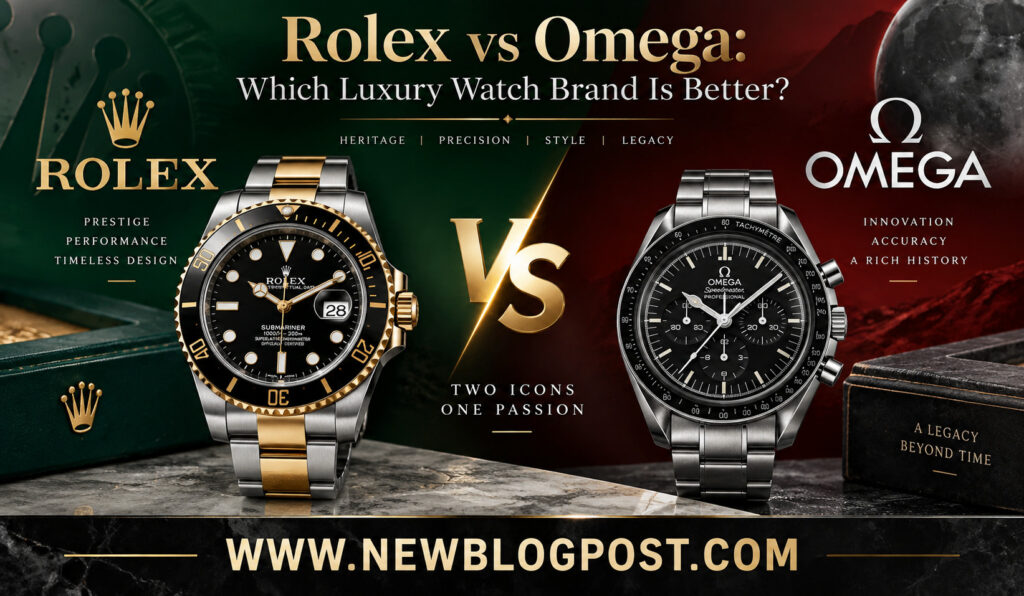

Picking between Rolex vs Omega feels harder than it should be, mostly because both brands do so many things right. If you are shopping for your first serious watch, this comparison walks through history, design, movement quality, price, and resale value so you can make a choice that actually fits you, not just your Instagram feed.
Brand History and Reputation
Rolex was founded in 1905 by Hans Wilsdorf, and it built its name on precision and durability. Omega dates back even earlier, to 1848, and it carries a long record tied to space missions and diving expeditions.
Both brands have earned serious credibility over the decades, just through different paths.
A Quick Look at Their Milestones
- Rolex: First waterproof watch (Oyster, 1926), first watch to reach the summit of Everest in 1953.
- Omega: First watch worn on the moon during the Apollo 11 mission in 1969, longtime timekeeper of the Olympic Games.
Rolex leaned into exploration and record breaking on Earth. Omega, on the other hand, leaned into space and sport. Neither story is better, they are just different flavors of prestige.
Design and Style Differences
Rolex sticks to a handful of iconic shapes and rarely strays far from them. The Submariner, Datejust, and GMT-Master II have barely changed their silhouette in decades.
Omega takes more risks with case shapes, dial textures, and color options. The Seamaster and Speedmaster lines offer noticeably more variety than most Rolex collections.
Here is a simple breakdown of the design philosophy each brand follows:
- Rolex: Minimal changes over time, instantly recognizable shapes, conservative dial layouts.
- Omega: More experimental colorways, varied case finishes, willingness to update designs more often.
If you want a watch that looks the same in twenty years as it does today, Rolex is the safer bet. If you like a bit more personality on your wrist, Omega gives you more room to play.
Movement and Technology
Both brands manufacture their own movements in house, which is not something every luxury watchmaker can claim. Rolex uses its own calibers across nearly the entire lineup, built for long term reliability rather than flashy complications.
Omega, meanwhile, has pushed harder into cutting edge tech with its Co-Axial escapement, developed with independent watchmaker George Daniels. This escapement reduces friction inside the movement, which can extend the time between services.
Key Technical Points
- Rolex movements are known for simplicity and toughness, with fewer moving parts to fail.
- Omega’s Co-Axial movements aim for lower friction and longer service intervals.
- Both brands carry chronometer certification on most models, meaning the movements meet strict accuracy standards.
Neither approach is objectively superior. Rolex prioritizes proven simplicity, and Omega prioritizes technical innovation.
Price and Resale Value
This is where the two brands really start to separate. Rolex watches, especially steel sports models, often hold their value extremely well, and some models even sell above retail price on the secondary market.
Omega watches, while still solid performers, generally do not command the same premiums once resold. You can expect a larger initial price drop on most Omega models compared to Rolex.
A rough comparison for entry level sport models:
- Rolex Oyster Perpetual: Starts around retail price, tends to hold value well over time.
- Omega Seamaster Diver 300M: Starts at a lower retail price, but the resale value drops faster in the first few years.
If resale value matters to you as much as owning the watch itself, Rolex tends to be the stronger financial choice.
Which Brand Fits Your Lifestyle
Your daily habits and personal taste should guide this decision more than brand hype. Someone who wants one watch for the rest of their life might lean toward Rolex, since the designs rarely change and the resale market stays strong.
Someone who enjoys variety, or who wants a watch tied to a specific passion like space exploration or diving history, might connect more with Omega.
Think about these questions before deciding:
- Do you want a watch that holds resale value, or one that reflects a personal story?
- Do you prefer classic, unchanging design, or more variety across collections?
- Is chronometer certification and Co-Axial tech a selling point for you, or is simplicity enough?
There is no wrong answer here, only the one that matches how you actually think about watches.
Key Takeaways
- Heritage: Rolex focuses on exploration and toughness, Omega focuses on space and sport history.
- Design: Rolex stays conservative, Omega experiments more with color and case styles.
- Movement: Rolex favors simplicity, Omega pushes newer Co-Axial technology.
- Resale value: Rolex generally holds value better than Omega.
- Best fit: Choose based on your personal taste and how much resale value matters to you.
FAQs
Is Rolex really better than Omega?
Neither brand is strictly better, since Rolex and Omega simply serve different priorities around design, technology, and resale value.
Which brand has better resale value, Rolex or Omega?
Rolex generally holds its resale value better than Omega, particularly among steel sport models.
Does Omega use the same quality movements as Rolex?
Omega uses in house Co-Axial movements that are considered highly capable, though they follow a different engineering philosophy than Rolex movements.
Is Omega a good starter luxury watch brand?
Omega is often considered a strong starter luxury brand because of its lower entry price compared to Rolex.
Which brand offers more design variety?
Omega generally offers more design variety across colors, case finishes, and collections than Rolex.
Conclusion
Choosing between Rolex vs Omega comes down to what you personally value in a watch. Rolex offers steady design, dependable movements, and stronger resale value, while Omega offers more variety, genuine technical innovation, and a rich history tied to space and sport. Both brands have earned their reputation the hard way, through decades of craftsmanship, so you really cannot go wrong picking either one for the right reasons.