
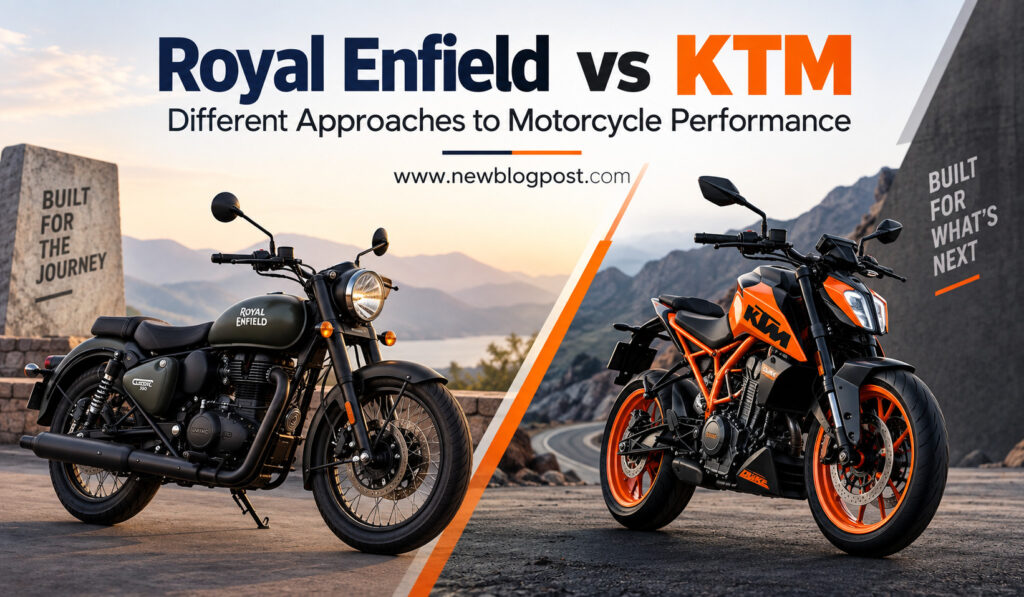

Royal Enfield and KTM are two motorcycle brands with very different ideas about performance. Both have developed strong identities in the Indian market, but they appeal to riders through contrasting approaches. Royal Enfield generally combines engine character, relaxed riding and distinctive styling with a strong sense of heritage. KTM, meanwhile, focuses heavily on acceleration, sharp handling, lightweight construction and technology derived from performance riding.
This difference makes a comparison between Royal Enfield and KTM particularly interesting. A rider choosing between the two is not simply deciding between two motorcycles. They are choosing between two different interpretations of what makes a motorcycle exciting.
Royal Enfield’s current Indian range includes motorcycles such as the Classic 350, Guerrilla 450, Himalayan 450, Interceptor 650 and Continental GT 650. KTM’s Indian lineup includes motorcycles such as the 250 Duke, 390 Duke, 390 Duke R and RC 390, each approaching performance from a more aggressive direction.
Royal Enfield Focuses on Engine Character and Riding Experience
Royal Enfield’s approach to performance is closely connected with its brand identity. Instead of making every motorcycle feel race-oriented, the company places considerable emphasis on torque delivery, mechanical character and relaxed long-distance riding.
The Classic 350 is a clear example. Its 349cc single-cylinder engine produces 20.2 bhp at 6,100 rpm and 27 Nm of torque at 4,000 rpm, paired with a five-speed gearbox. These figures are modest compared with KTM’s performance-oriented motorcycles, but the Classic 350 is not designed around outright acceleration.
Its appeal comes from the way the engine delivers its performance. The motorcycle is designed to feel composed and substantial rather than aggressively sporty.
This philosophy makes Royal Enfield attractive to riders who enjoy relaxed cruising, predictable acceleration and a strong mechanical feel.
KTM Prioritises Immediate Performance
KTM takes a more performance-focused approach. Its motorcycles are generally developed around sharp responses, strong acceleration and agile handling.
The difference becomes obvious when looking at the KTM 390 Duke. The current KTM India listing describes the motorcycle with a 399cc-class LC4c liquid-cooled engine, while KTM’s current Click & Collect information lists the 390 Duke with 349.32cc, 41.5 PS and 33.5 Nm. The exact specification should therefore be checked against the specific current variant when publishing model-specific figures.
Regardless of the variant, KTM’s philosophy is clear: deliver a much more performance-oriented riding experience than a conventional commuter or relaxed roadster.
The KTM 390 Duke also incorporates advanced rider aids and performance technology, reinforcing the brand’s focus on active riding.
Engine Size Does Not Tell the Whole Story
Comparing engine displacement alone can be misleading.
The Royal Enfield Classic 350 uses a relatively simple 349cc single-cylinder engine, while KTM’s performance motorcycles use compact engines designed for significantly stronger output.
For example, the KTM RC 390 uses a 373.27cc liquid-cooled single-cylinder engine producing 43.5 PS at 9,000 rpm and 37 Nm at 7,000 rpm. Those figures illustrate how differently KTM approaches engine performance.
Royal Enfield, on the other hand, has expanded its performance capabilities with its newer 452cc Sherpa engine. The Guerrilla 450 and Himalayan 450 use this 452cc liquid-cooled single-cylinder platform, producing 40.02 PS and 40 Nm in the specifications published by Royal Enfield.
This gives Royal Enfield a stronger performance offering than its traditional 350cc motorcycles while retaining its own riding character.
Royal Enfield Emphasises Torque and Usable Performance
Royal Enfield’s newer motorcycles demonstrate how the company is moving toward stronger performance without abandoning its core identity.
The Guerrilla 450 is a good example. Its 452cc engine produces 40.02 PS at 8,000 rpm and 40 Nm at 5,500 rpm, with a six-speed gearbox and ride-by-wire fuel management.
This provides considerably more performance than the Classic 350 while still being packaged as a road-focused motorcycle.
The Himalayan 450 uses the same basic 452cc engine concept but is engineered around adventure riding. Its higher ground clearance, long-travel suspension and adventure-oriented chassis give it a very different purpose from the Guerrilla.
Royal Enfield therefore does not treat performance as a single category. Instead, it adapts the engine and chassis to different riding styles.
KTM Places Greater Emphasis on Agility
KTM’s performance identity is strongly connected with lightweight handling and rider involvement.
The RC 390 demonstrates this philosophy particularly well. It uses a split-trellis frame, WP APEX upside-down front forks and a rear monoshock. Its specification also includes motorcycle traction control, Quickshifter+, Cornering ABS and Supermoto ABS.
These features are designed to give the rider greater control during enthusiastic riding.
The KTM approach is therefore not simply about making the engine powerful. The chassis, suspension, electronics and ergonomics are developed around the expectation that riders will actively explore the motorcycle’s performance.
This makes KTM particularly appealing to enthusiasts who enjoy corners, quick acceleration and sporty riding dynamics.
Royal Enfield Offers a More Relaxed Performance Personality
Royal Enfield’s motorcycles generally create a different experience.
The Continental GT 650, for example, has a 648cc parallel-twin engine producing 47.4 PS and 52.3 Nm according to the manufacturer’s current specifications. It also uses a six-speed gearbox and a steel double-cradle frame.
Despite its café-racer design, the Continental GT 650 is not simply a stripped-down track motorcycle. Its character combines performance with classic styling and a strong emphasis on riding enjoyment.
The Interceptor 650 follows an even more relaxed roadster formula. It offers the same broad engine platform but has an upright riding position and a more versatile character.
This demonstrates an important part of Royal Enfield’s philosophy: performance should complement the motorcycle’s character rather than completely define it.
KTM Makes Technology Part of the Performance Experience
Technology is another area where KTM takes a distinctly performance-oriented approach.
The RC 390, for example, features a TFT multifunction display, ride-by-wire technology, motorcycle traction control, Cornering ABS and Quickshifter+.
The KTM 390 Duke R goes even further, with a 398.63cc engine producing 46 PS and 39 Nm, along with adjustable suspension, Cornering ABS, Supermoto ABS, launch control and a track screen.
These features demonstrate KTM’s emphasis on giving riders greater control over performance.
For enthusiasts, electronic rider aids can make a motorcycle more engaging because they allow different aspects of the bike’s behaviour to be managed according to riding conditions.
Design Reflects the Different Brand Philosophies
The difference between the brands is also visible in their designs.
Royal Enfield motorcycles typically use classic proportions, rounded elements, metal-inspired finishes and designs that connect modern motorcycles with the company’s heritage.
The Classic 350, Interceptor 650 and Continental GT 650 all demonstrate this approach in different ways.
KTM follows a much more aggressive visual language. Sharp bodywork, angular surfaces and distinctive lighting create a futuristic and sporty appearance.
The RC 390 takes this even further with full fairing and race-inspired bodywork, while the Duke models use exposed mechanical components and aggressive streetfighter styling.
Therefore, choosing between Royal Enfield and KTM can also come down to personal design preference.
Different Riders, Different Definitions of Performance
The most important difference between Royal Enfield and KTM is that their motorcycles are designed around different rider expectations.
A Royal Enfield may appeal to someone who values relaxed cruising, strong low- and mid-range character, distinctive styling and long-distance comfort.
A KTM may be more attractive to someone who wants quick acceleration, sharper steering, advanced electronics and an energetic riding experience.
Neither philosophy is universally better.
A rider who spends most weekends travelling on highways may appreciate the relaxed character of an Interceptor 650 or Himalayan 450. Someone who enjoys spirited cornering may prefer a KTM Duke or RC motorcycle.
Which Brand Is Better for Indian Riders?
The answer depends heavily on how the motorcycle will be used.
Royal Enfield’s broad portfolio provides options ranging from the accessible Classic 350 to the performance-oriented Guerrilla 450 and larger 650cc motorcycles. Its Himalayan 450 also gives riders an adventure-focused alternative.
KTM provides a more performance-focused lineup, with the 250 Duke, 390 Duke, 390 Duke R and RC 390 catering to riders who place greater emphasis on acceleration and sporty dynamics.
The decision should therefore be based on riding style rather than brand reputation alone.
Conclusion
Royal Enfield and KTM represent two distinct approaches to motorcycle performance in India.
Royal Enfield builds performance around engine character, torque delivery, heritage, comfort and an engaging but generally relaxed riding experience. Its newer 450cc and 650cc motorcycles demonstrate that the company can offer considerably more performance while maintaining its distinctive personality.
KTM takes a sharper approach, placing greater emphasis on acceleration, agility, sophisticated rider aids and performance-focused chassis engineering. Its Duke and RC motorcycles are aimed at riders who want a more aggressive connection between rider and machine.
Ultimately, the better choice depends on what a rider expects from a motorcycle. Royal Enfield is well suited to buyers who appreciate character and relaxed performance, while KTM is particularly appealing to those who want sharper dynamics and a more intense riding experience. Both brands demonstrate that motorcycle performance can be defined in very different ways.