
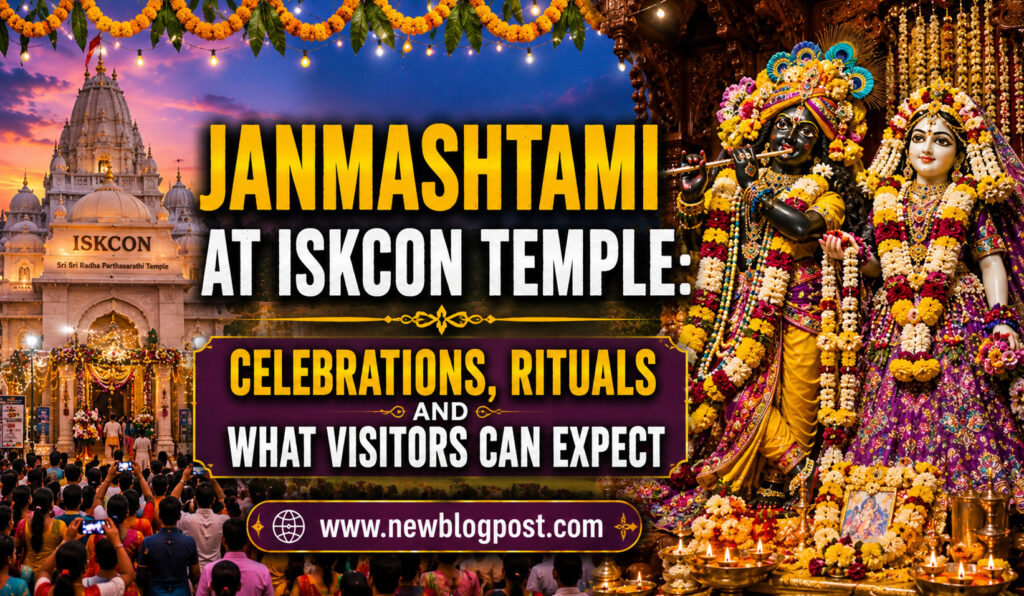

Celebrations, Rituals and What Visitors Can Expect
Janmashtami is one of the most widely celebrated festivals in the Hindu calendar, marking the birth of Lord Krishna. Every year, temples across India transform into vibrant centres of devotion, music, prayer and cultural activities. Among them, ISKCON temples are known for organising elaborate Janmashtami celebrations that combine traditional Vaishnavite practices with devotional singing, spiritual talks and community participation.
For devotees and travellers, Janmashtami at an ISKCON temple offers a different experience from an ordinary temple visit. The atmosphere begins changing well before midnight, with devotees gathering for kirtans, bhajans, special prayers and cultural programmes. As the festival reaches its traditional midnight climax, temples become filled with chants of “Hare Krishna” and “Hare Rama,” creating an energetic yet deeply devotional environment.
ISKCON, formally known as the International Society for Krishna Consciousness, operates temples and centres in many parts of India and around the world. While the details of celebrations vary from one temple to another, the central focus remains the worship of Sri Krishna and remembrance of his divine appearance.
What Is Janmashtami?
Janmashtami commemorates the appearance of Lord Krishna, who is traditionally believed to have been born at midnight on the eighth day of the dark fortnight of the month of Bhadrapada.
According to Hindu tradition, Krishna was born in Mathura to Devaki and Vasudeva. His birth took place under difficult circumstances because Devaki’s brother, King Kamsa, feared a prophecy that predicted his downfall through Devaki’s child.
The traditional story describes how Vasudeva carried the newborn Krishna across the Yamuna River to Gokul, where he was raised by Nanda Maharaj and Yashoda. These stories form an important part of Krishna devotion and are remembered through prayers, dramatic performances, music and storytelling during Janmashtami.
At ISKCON temples, the festival places particular emphasis on Krishna’s teachings, devotion and loving relationship with his devotees.
Why Janmashtami Is Special at ISKCON Temples
Janmashtami is among the biggest annual festivals observed by ISKCON communities. The celebrations are designed not only as religious ceremonies but also as opportunities for people to participate in devotional activities.
The atmosphere typically begins building during the day. The temple premises may be decorated with flowers, lights and artistic displays depicting scenes from Krishna’s life. Devotees gather for chanting, spiritual discourses and devotional programmes.
As evening approaches, the number of visitors generally increases. Families arrive with children, young people participate in kirtans, and devotees from different cities may travel specifically to attend the celebration.
The midnight period is the emotional centre of the festival. Krishna’s appearance is traditionally celebrated at midnight, followed by special worship and devotional offerings.
Because ISKCON centres differ in size and local arrangements, the exact programme varies. Visitors should check the specific temple’s official announcement before making travel plans.
A Day of Devotion and Fasting
For many devotees, Janmashtami begins with fasting and spiritual preparation. Devotees may observe a fast during the day and spend time chanting the Hare Krishna maha-mantra, reading scriptures and participating in temple activities.
ISKCON’s devotional tradition places strong importance on bhakti, or loving devotion to Krishna. Consequently, Janmashtami is not treated simply as a birthday celebration. It is an opportunity to remember Krishna, hear about his teachings and deepen one’s spiritual practice.
The fasting practices followed by individual devotees can differ. Some observe a complete fast for a particular period, while others follow specific dietary restrictions. Visitors who are unfamiliar with fasting traditions should not feel pressured to participate. The festival can be experienced through prayer, music, darshan and cultural programmes as well.
Temple Decorations and Krishna-Themed Displays
One of the first things visitors notice during Janmashtami is the decoration of the temple.
ISKCON temples often create elaborate floral arrangements, illuminated spaces and displays representing episodes from Krishna’s life. Images of Krishna with Radha, scenes from Vrindavan and representations of Krishna’s childhood may form part of the festival environment.
The decorations serve both devotional and educational purposes. Children and first-time visitors can become familiar with stories from Krishna’s life through visual displays.
Some temples also organise special exhibitions explaining Krishna consciousness, the Bhagavad Gita and the teachings of Srila Prabhupada, the founder-acharya of ISKCON.
For visitors interested in photography, the decorated temple premises can be visually attractive. However, photography and video recording may be restricted in certain areas, particularly around the main altar. Visitors should always follow local temple instructions.
Kirtan and Bhajan: The Sound of Janmashtami
Music is one of the defining features of Janmashtami at ISKCON.
The Hare Krishna maha-mantra is repeatedly chanted during kirtans, often accompanied by traditional instruments such as mridangas and kartals. Devotees may sing together for extended periods, creating an atmosphere of collective participation.
Unlike a performance where visitors simply watch from a distance, kirtan encourages people to join the chanting. Even first-time visitors can participate at their own comfort level.
The devotional music becomes particularly energetic as midnight approaches. The combination of chanting, musical instruments and the anticipation of Krishna’s appearance creates one of the most memorable moments of the celebration.
For many visitors, this collective experience is what makes an ISKCON Janmashtami celebration distinctive.
Midnight Krishna Appearance Ceremony
The midnight ceremony is the central moment of Janmashtami.
According to tradition, Lord Krishna appeared at midnight. At ISKCON temples, the occasion is marked by special worship of the deity, devotional chanting and ceremonial activities.
The deity may be given a maha-abhishek, or ceremonial bathing, using various auspicious substances according to the temple’s ritual traditions. After the ceremony, Krishna is dressed in special festival attire and decorated with ornaments and flowers.
The exact ritual sequence varies between temples, but visitors can generally expect a highly devotional atmosphere around midnight.
The temple may become extremely crowded during this period. People who want to attend the midnight ceremony should be prepared for security checks, queues and restricted movement.
Abhishekam and Special Deity Darshan
One of the most important ritual experiences during Janmashtami is the special darshan of Krishna.
The deity is treated with great reverence and may be dressed differently throughout the festival. During special ceremonies, devotees gather to witness abhishekam and other rituals.
In ISKCON tradition, deity worship is an important aspect of devotional practice. The carefully prepared altar, flowers, clothing, jewellery and offerings contribute to the sacred atmosphere.
For visitors, it is worth remembering that temple rituals are not staged performances. They are active religious practices, and visitors should maintain appropriate behaviour while observing them.
Cultural Programmes and Spiritual Discourses
Janmashtami celebrations often include cultural programmes in addition to religious rituals.
Devotional dramas, classical or traditional dance performances, storytelling sessions and musical programmes may be organised to explain episodes from Krishna’s life. These programmes are particularly popular with families because they introduce children to Indian mythology and devotional traditions in an engaging format.
Spiritual talks may also focus on Krishna’s teachings from texts such as the Bhagavad Gita and Srimad Bhagavatam. Speakers explain concepts such as devotion, dharma, karma and the purpose of spiritual life.
The combination of culture and philosophy means that visitors can experience Janmashtami at different levels. Some may attend primarily for darshan, while others may spend several hours listening to discourses and participating in kirtans.
Prasadam and Festive Food
Food has an important place in temple celebrations, although Janmashtami fasting changes when and how devotees eat.
After the fasting period, devotees may receive prasadam, food that has been offered to Krishna. ISKCON temples are particularly known for distributing vegetarian prasadam as part of their community activities.
The menu varies from temple to temple and may include traditional Indian preparations. During large celebrations, prasadam distribution can involve significant logistical arrangements because of the number of visitors.
Visitors should follow the temple’s instructions regarding fasting, meal timings and prasadam distribution. Those with dietary restrictions should also plan accordingly.
What Visitors Can Expect on Janmashtami
People attending an ISKCON temple for the first time may find the festival much busier than an ordinary day.
The experience generally involves a combination of devotional music, temple darshan, cultural programmes and long periods of waiting or standing, especially around the midnight ceremony.
| What to Expect | Typical Experience |
| Temple crowd | Very high, particularly in the evening |
| Main celebration | Midnight Krishna appearance |
| Music | Kirtan, bhajan and devotional chanting |
| Rituals | Darshan, abhishekam and special worship |
| Food | Fasting followed by prasadam |
| Family activities | Cultural programmes and Krishna-themed displays |
| Security | Additional checks and crowd-management measures |
The exact schedule, entry rules and programme structure can vary significantly between ISKCON temples.
Best Time to Arrive
Visitors who want to attend the full Janmashtami celebration should avoid arriving shortly before midnight. Large crowds can build several hours in advance.
Arriving earlier provides an opportunity to explore the decorations, attend kirtans and find out where different programmes are taking place.
However, visitors should also consider their own comfort. Spending several hours in a crowded temple can be tiring, particularly for young children and elderly family members.
A practical approach is to check the temple’s published schedule and choose specific programmes rather than attempting to attend every activity.
Important Tips for First-Time Visitors
Janmashtami is a major religious event, so visitors should prepare differently than they would for a normal sightseeing trip.
- Check the temple’s official Janmashtami schedule before travelling.
- Arrive early if you want to attend the midnight celebration.
- Wear comfortable and appropriate clothing.
- Carry minimal belongings because security checks may take additional time.
- Stay close to children and elderly family members, especially when the temple gets crowded.
- Follow instructions regarding photography, footwear, queues and restricted areas.
It is also sensible to avoid bringing unnecessary valuables. Large crowds can make movement difficult, particularly during the main ceremony.
Janmashtami for Families and Children
For families, an ISKCON Janmashtami celebration can be an educational as well as spiritual experience.
Children can learn about Krishna’s childhood stories through decorations, dramas and storytelling. Some ISKCON centres organise special activities designed specifically for younger visitors, although programmes differ from one location to another.
Parents should remember that the midnight celebration may extend late into the night. Younger children may become tired before the main ceremony begins. Planning breaks and carrying essentials such as water can make the experience more comfortable.
The festival also offers an opportunity for parents to explain concepts of kindness, devotion, responsibility and compassion through stories associated with Krishna.
Janmashtami and the Spirit of Community
Another defining feature of Janmashtami at ISKCON is the sense of community.
Volunteers play an important role in managing queues, distributing prasadam, guiding visitors and supporting temple activities. Devotees often work together for weeks before the festival to prepare decorations and programmes.
The large gathering demonstrates how religious festivals can bring people from different backgrounds together. Visitors may find devotees travelling long distances, families participating together and volunteers dedicating their time to serving others.
This community aspect is one of the reasons Janmashtami continues to attract both regular devotees and people experiencing ISKCON for the first time.
How Janmashtami Has Evolved in Modern Times
While the spiritual foundation of Janmashtami remains traditional, modern technology has changed how people experience the festival.
Many ISKCON temples now use digital announcements, online registration systems, livestreaming and social media to communicate festival schedules. This can help devotees who cannot physically travel to participate in prayers and celebrations remotely.
At the same time, physical attendance remains central to the experience for many devotees. The sound of a live kirtan, the decorated deity and the shared atmosphere of the midnight celebration cannot be fully reproduced through a screen.
The combination of traditional devotion and modern communication has allowed Janmashtami celebrations to reach audiences far beyond the temple premises.
Conclusion
Janmashtami at an ISKCON Temple is an experience that brings together devotion, music, culture and community. From the colourful decorations and continuous kirtans to spiritual talks, deity worship and the midnight celebration, the festival offers visitors a close look at the devotional traditions surrounding Lord Krishna.
For first-time visitors, preparation is essential. Janmashtami attracts significantly larger crowds than an ordinary temple day, so checking the official schedule, planning transportation and arriving early can make the visit more comfortable.
More importantly, visitors should approach the celebration with respect for its religious character. Whether someone attends for spiritual reasons, cultural interest or simply to understand the festival better, Janmashtami at ISKCON provides an opportunity to experience one of India’s most vibrant devotional celebrations in a deeply communal setting.
Frequently Asked Questions
1. What is celebrated on Janmashtami?
Janmashtami commemorates the appearance or birth of Lord Krishna. It is traditionally observed on the eighth day of the dark fortnight of the month of Bhadrapada, with the main celebration taking place around midnight.
2. What happens at ISKCON temples on Janmashtami?
ISKCON temples generally organise special deity darshan, kirtans, bhajans, spiritual talks, cultural programmes, abhishekam and a midnight celebration marking Krishna’s appearance. The exact programme varies by temple.
3. Can anyone attend Janmashtami at an ISKCON temple?
Generally, ISKCON Janmashtami celebrations are open to visitors, but individual temples may introduce entry arrangements, registrations or crowd-control measures for major events. Visitors should check the specific temple’s latest announcement.
4. Is fasting compulsory for visitors?
No. Fasting is a devotional practice followed by many devotees, but visitors should not assume that they must fast. Different people follow different practices, and visitors can participate in the celebration through darshan, chanting and other activities.
5. Why is the main Janmashtami celebration held at midnight?
According to traditional accounts, Lord Krishna appeared at midnight. Therefore, the midnight period is considered the central moment of Janmashtami observance.