
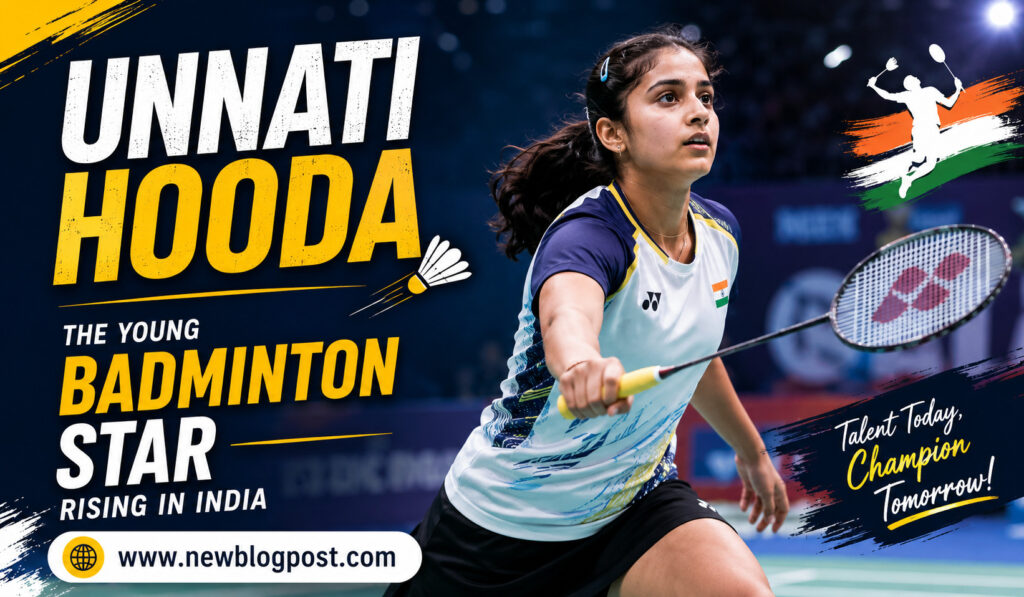

Indian badminton has become one of the country’s most successful individual sports, producing Olympic medallists, world champions and international stars. While players such as P. V. Sindhu and Saina Nehwal have inspired an entire generation, a new group of young shuttlers is now working to build its own identity on the global stage.
Among them is Unnati Hooda, a talented women’s singles player from Haryana who has already achieved several important milestones at a remarkably young age.
Her rise has attracted attention because she has competed successfully at junior and senior levels while gaining experience against players from different countries. Although she is still developing, her early achievements suggest that she could become an important player in the future of Indian badminton.
Who Is Unnati Hooda?
Unnati Hooda is an Indian badminton player who competes primarily in women’s singles. Born in Rohtak, Haryana, she began playing badminton at a young age and developed through India’s competitive junior badminton system.
Haryana has produced athletes across several sports, and badminton has also benefited from the state’s growing sporting infrastructure. For young players like Unnati, access to coaching and competitive tournaments can make a significant difference during the early stages of their careers.
What makes her journey particularly interesting is the speed of her progress. She started gaining national attention as a teenager and soon began competing at senior international events.
An Early Breakthrough in Indian Badminton
Unnati’s rise became particularly noticeable when she began producing strong results in junior competitions.
One of the most important achievements of her early career came at the 2022 Odisha Open, where she became the youngest Indian to win a BWF World Tour title at the age of 14 years and 8 months.
The achievement was significant because she was competing against senior players rather than only athletes in her own age category.
Winning a senior international tournament at such a young age demonstrated that Unnati had the confidence and competitive ability to handle pressure.
It also placed her name among India’s most promising young women’s singles players.
Success at the Junior Level
Junior badminton played an important role in Unnati’s development.
She represented India at major age-group competitions and gained experience against some of the world’s strongest young players. International junior tournaments can be challenging because athletes must adjust to different playing styles, conditions and tournament environments.
Unnati’s performances at this level helped establish her as a player with significant potential.
Junior success, however, is only the beginning. The transition to senior badminton requires greater physical strength, tactical maturity and consistency.
For Unnati, learning how to convert her junior achievements into long-term senior success is now one of the most important parts of her journey.
What Makes Unnati Hooda Special?
One of Unnati’s biggest strengths is her aggressive approach to singles badminton.
Women’s singles requires players to cover the entire court while maintaining concentration during long rallies. A player needs excellent footwork, stamina and shot control to create opportunities against defensive opponents.
Unnati has shown that she is comfortable playing attacking badminton and looking for ways to put opponents under pressure.
Her speed around the court also helps her maintain rallies and recover quickly after difficult shots.
As she gains more senior-level experience, developing greater tactical variety will allow her to become even more difficult to play against.
The Importance of Her Playing Style
Modern badminton is increasingly physical and fast. Successful singles players need to combine attacking shots with strong defensive movement.
Unnati’s willingness to play aggressively can give her an advantage against opponents who struggle to deal with pace.
However, aggressive badminton also requires discipline. Taking unnecessary risks can lead to unforced errors, particularly against experienced players who know how to change the rhythm of a match.
Learning when to attack and when to construct a rally patiently will be an important part of Unnati’s development.
India’s Growing Women’s Badminton Talent Pool
Unnati’s rise is part of a broader development in Indian women’s badminton.
The success of Saina Nehwal and P. V. Sindhu has encouraged more young girls to pursue badminton professionally. Their achievements have also helped create greater investment in coaching, academies and high-performance training.
As a result, India’s pool of young women’s singles players has become increasingly competitive.
This is important for the future because international badminton requires a steady supply of players capable of competing at major tournaments.
Unnati is one of the young players who could contribute to that future.
Learning From India’s Established Stars
Young athletes benefit enormously from observing players who have already competed at the highest level.
For Unnati, India’s established badminton stars provide examples of how to prepare for major tournaments, handle difficult losses and maintain physical fitness throughout a long season.
P. V. Sindhu’s career, in particular, demonstrates how important consistency and mental strength are in women’s singles badminton.
Unnati does not need to follow the exact same path. Every player develops a unique style. But learning from successful athletes can help young shuttlers understand the professional habits required to build a sustainable career.
Challenges Facing Unnati Hooda
Despite her early achievements, Unnati still has several challenges to overcome.
The biggest is consistency. Winning a tournament at a young age is impressive, but staying competitive against experienced players over multiple seasons is much harder.
Physical development will also be important. Senior women’s singles matches can involve long rallies and demanding tournament schedules, requiring excellent stamina and recovery.
Tactical maturity is another key area. As opponents become familiar with Unnati’s strengths, they will look for ways to neutralise her attacking game.
She will need to develop different strategies and scoring patterns to remain unpredictable.
Mental strength will also be essential. A young player who receives attention early in her career must learn to deal with expectations without allowing them to affect performance.
Can Unnati Hooda Become India’s Next Badminton Star?
It is impossible to predict exactly how far Unnati’s career will go. Badminton careers involve many variables, including injuries, competition, form and the ability to adapt to changes in the sport.
However, her early achievements provide a strong foundation.
Becoming one of India’s youngest BWF World Tour winners demonstrated that she can compete successfully at senior level. Her junior experience has also given her exposure to international competition.
If she continues improving her fitness, tactical understanding and consistency, she could become a significant player on the international circuit.
The key will be steady development rather than rushing the process.
Why the Next Few Years Matter
The coming years will be crucial for Unnati.
She will need regular exposure to senior international tournaments to gain experience against higher-ranked opponents. Every tournament can help her understand the demands of professional badminton.
Her ranking will also become increasingly important as she attempts to qualify for bigger events and compete against the world’s leading players.
Managing tournament schedules and physical recovery will become more challenging as the level of competition increases.
If she can stay healthy and continue developing, her progress could be one of the most interesting stories in Indian women’s badminton.
The Future of Indian Women’s Singles
India has already demonstrated that its women’s singles players can compete for the biggest prizes in world badminton.
The emergence of young talents such as Unnati Hooda provides hope that the country can maintain a strong presence after its current generation eventually steps away from international competition.
A successful pipeline of young players creates healthy competition and ensures that India’s national badminton program continues to have strong options.
Unnati’s development could therefore be important not only for her own career but also for the future depth of Indian women’s singles.
Conclusion
Unnati Hooda is one of India’s most exciting young badminton talents, and her early career has already produced some remarkable achievements. Her success at the Odisha Open demonstrated that she could compete against senior opposition at an unusually young age.
Her attacking style, court movement and competitive confidence provide a strong foundation for future growth. However, continued success will require consistency, physical development, tactical intelligence and mental resilience.
The journey from teenage sensation to established international star is never easy. Unnati still has plenty to learn, but she has already shown that she belongs in the conversation about India’s next generation of badminton talent.
As Indian badminton continues to grow, fans will be watching closely to see how far Unnati Hooda can go. If her development continues in the right direction, she could become an important name in Indian women’s singles and another player capable of carrying India’s badminton ambitions onto the world stage.